
Leadership · SME · Momentum
Small Teams Need Different Leadership
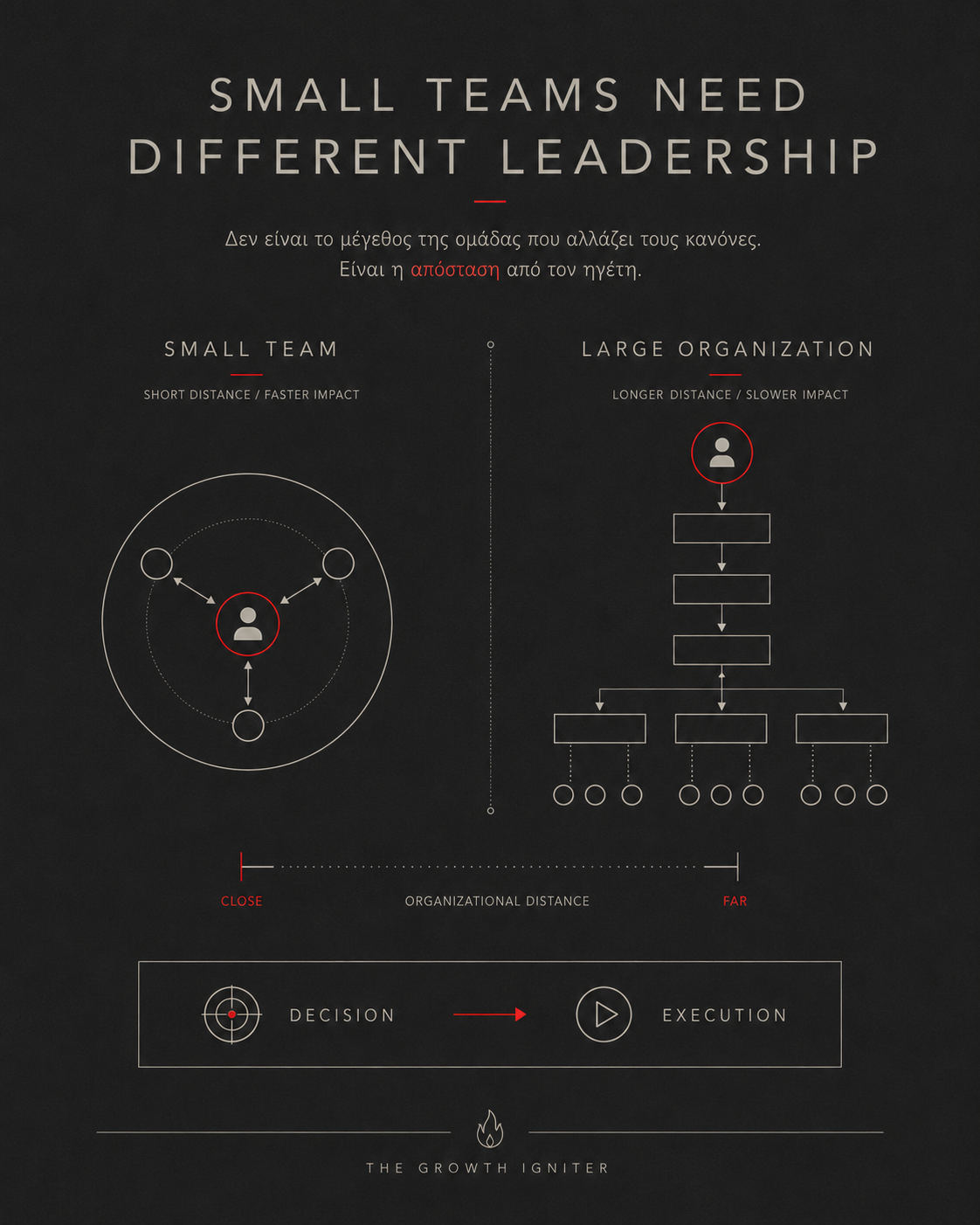
It is not the size of the team that changes the rules. It is the distance from the leader.
Most leadership theories have been written for large organizations.
For multinationals.
For companies with five levels of management.
For organizational charts where the CEO is three or four levels away from the person serving the customer.
But the reality of Greek business is different.
Most businesses have 5, 10, 20 or 50 people.
And a team of 10 people is not simply a smaller version of a company of 10,000 people.
For the same reason that a motorcycle is not a small car.
Or a drone is not a small airplane.
They obey the same laws. But their behavior is entirely different.
The same applies to small teams.
Consider two companies
The first has 20 employees.
The CEO decides in the morning to change something.
By midday, the change may already have been implemented.
The second has 20,000 employees.
The same decision must pass through:
- Director.
- VP.
- Regional Director.
- Country Manager.
- Middle Management.
- Team Leaders.
By the time it reaches the person who must implement it, the decision has traveled through an entire management chain.
Each level adds time. Interpretation. Approval. Waiting. And the possibility of distortion.
The first company has fewer resources. But it has something the second struggles to maintain:
a short distance between decision and action.
To Organizational Distance
Perhaps the most important variable in a business is not just its size.
It is also Organizational Distance, meaning the distance between Decision → Execution.
The greater this distance, the more energy is lost.
Like an electrical circuit. Like a water pipe. Like a drive chain.
Each link creates small losses. None seems decisive on its own. Together, however, they can absorb a large share of the organization's energy.
Organizational Momentum ≈ Useful Energy − Organizational Distance
Not because distance is always bad. As a business grows, it needs roles, structures and levels of responsibility.
But each new level requires more communication, more approvals, more interpretations and more waiting. In other words: more friction.
In the Momentum Equation, friction is subtracted from useful energy before that energy is converted into actual movement:
Momentum = (Useful Energy − Friction) × Alignment
Organizational Distance is one of the most significant sources of this friction.
And this is where the small team's natural advantage lies.
It can turn a sound decision into action much faster. Provided it does not destroy that speed itself.
A short distance does not transmit only sound decisions
A short organizational distance acts as an amplifier. It does not amplify only what is right. It amplifies everything.
In a team of 12 people, the CEO's optimism can spread within a few hours.
So can their fear. Their confidence. Their doubt. Their decisiveness. Their insecurity.
A piece of good news can change the entire atmosphere within an hour.
An ill-judged remark can affect the team for a week.
A bold decision can send the team's confidence soaring.
Constant postponement can bring everything to a standstill.
There is no intermediate level to absorb the tension. There is no buffer.
That is why leadership in small businesses is so demanding. Proximity increases speed. But it also increases responsibility.
In small teams, everything is magnified
The CEO's bad mood. A moment of indecision. An unclear message. An email written under pressure. An ill-judged remark.
In an organization of 5,000 people, these may never reach most people.
In a team of 15 people, they can even become organizational culture.
In a large business, culture is shaped to a great extent by the system, meaning policies, procedures, management structures, symbols and mechanisms.
In small teams, culture is shaped primarily by behavior. It is not simply written in manuals. It is copied from the leader every day.
People observe:
- how the leader reacts under pressure,
- how the leader listens,
- how the leader disagrees,
- how the leader decides,
- how the leader handles a mistake,
- how the leader behaves when results are poor.
The CEO of a company of 15 people is not simply its leader. They are its operating system.
The Leadership Resonance Model
In physics, resonance describes how a system can respond strongly to a stimulus of a specific frequency.
Something similar happens in small teams. Because distance is short and contact is frequent, the leader's influence is multiplied.
Leadership Resonance = (Energy × Clarity × Frequency) ÷ Distance
Energy
What energy does the leader transmit to the team? Composure or panic? Decisiveness or doubt? Belief or cynicism?
Clarity
How clear are the direction, priorities and decisions?
Frequency
How often does the team experience the leader's behavior and messages?
Distance
How many organizational levels are there between the leader and the people?
The shorter the distance, the greater the impact. For better. Or for worse.
Small teams become enthusiastic faster. They become disappointed faster. They change behavior faster. They lose momentum faster. And they can regain it faster.
They therefore do not simply need better managers. They need leaders who understand the physics of the oscillation they create.
The biggest trap for small businesses
Most founders start out as the best executors in their companies.
They sell. They produce. They solve problems. They serve customers. They make all the decisions.
At first, this is an advantage. The business moves because the founder has knowledge, speed, passion and the full picture.
But as the company grows, the founder often continues to operate in the same way. They want to see everything. Approve everything. Answer everything. Participate in everything.
The result? Everyone waits for the founder. For an approval. For an answer. For a decision. For confirmation.
And that is how the most capable person in the company becomes its biggest bottleneck.
The short organizational distance, which should be a competitive advantage, begins to grow artificially. There are not many levels of management. But there is one central waiting queue: the founder themselves.
In the book The Growth Igniter I argue that most businesses do not stop growing because they lack ideas.
They stop because leadership and the system do not evolve at the same pace.
The business grew. Its operating system remained designed for the time when everything could go through one person.
The four rules for managing a small team
Not forty. Four.
1. Speed is more important than perfection
Small businesses cannot compete with large ones in capital, infrastructure or human resources. But they can beat them on speed.
- Listen to the customer faster.
- Change a process faster.
- Test an idea faster.
- Correct a mistake faster.
If a small business needs weeks to make a decision it could make in two days, it has nullified its most important competitive advantage itself.
Speed, however, does not mean haste. It means a short distance between understanding, decision and implementation.
2. Clarity is more important than complexity
People do not need the "smartest" CEO. They need a CEO who can clearly explain:
- Where are we going?
- Why are we going there?
- What takes priority now?
- What does success mean?
- Who decides what?
If it takes three meetings to explain a decision, then the decision is probably not clear enough.
And the smaller the team, the greater the need for clarity. Because ambiguity does not remain individual. It quickly turns into collective inertia.
3. Repetition creates culture
Small teams do not need more presentations. They need consistent management habits.
- The same brief weekly meeting.
- Clear weekly priorities.
- A specific way of making decisions.
- A consistent approach to feedback.
- An agreed approach to handling problems.
Repetition creates predictability. Predictability creates security. Security creates trust. And trust enables autonomy.
Culture is not created by the values written on the wall. It is created by what is repeated under pressure.
4. The owner must stop being the bottleneck
This is perhaps the hardest part.
In most SMEs, the problem is not that people do not want to take responsibility. The problem is that the system has trained them to wait.
When every decision needs the owner's approval, the team stops exercising judgment.
When every mistake is corrected personally by the owner, people stop learning to solve problems.
When the founder always provides the final answer, the business is fast only when they are available.
The leader is not the person who solves all the problems. They are the person who creates the conditions for others to solve the right problems on their own.
This is a founder's biggest transition:
From: “They need me for everything.”
To: “They need me less and less for day-to-day operations and more and more for direction.”
This is not a loss of control. It is organizational maturity.
A simple diagnostic
Ask yourself:
- How many decisions this week were waiting solely on me?
- How many projects were delayed because I did not respond?
- How many people can make a sound decision without asking for my approval?
- How many times did I give an answer when I should have provided a framework?
- If I were away for a month, what would stop working?
And perhaps the hardest question:
Does my team truly depend on me, or have I trained it to depend on me?
If your answers concern you, the problem is probably not the quality of the team. It is the leadership system.
The biggest misconception
Most people believe that small businesses need more control.
I believe the opposite.
They need more clarity. Greater trust. A better rhythm. Faster decision-making. And less dependence on one person.
There are not simply small and large businesses.
There are businesses with a short or long distance between cause and effect.
And the greater this distance becomes, the more energy is required to produce the same result.
A thought before we close
Perhaps the next major management challenge is not only Artificial Intelligence. Perhaps it is reducing organizational distance.
Because AI can accelerate production. But it cannot fix an organization in which every important decision is still waiting on one person.
Businesses do not win because they make more decisions. They win because sound decisions translate into action before reality has a chance to change.
In a small team, this distance can become its strongest competitive advantage. Or its most expensive bottleneck.
Because a business does not mature simply by growing. It matures when it can keep moving without the founder constantly being at the center of everything.
In the book The Growth Igniter I argue that momentum is not the result of greater effort. It is the result of better system design.
And in small teams, the strongest element of that system is not the organizational chart. It is the leader themselves.
Because in small teams, leadership does not diffuse. It resonates.
A leader's job is not to make all the decisions. It is to create an organization that can make the right decisions even when the leader is not in the room.