
Leadership · Organizational Design · Momentum
Your company has two org charts. One is fake.
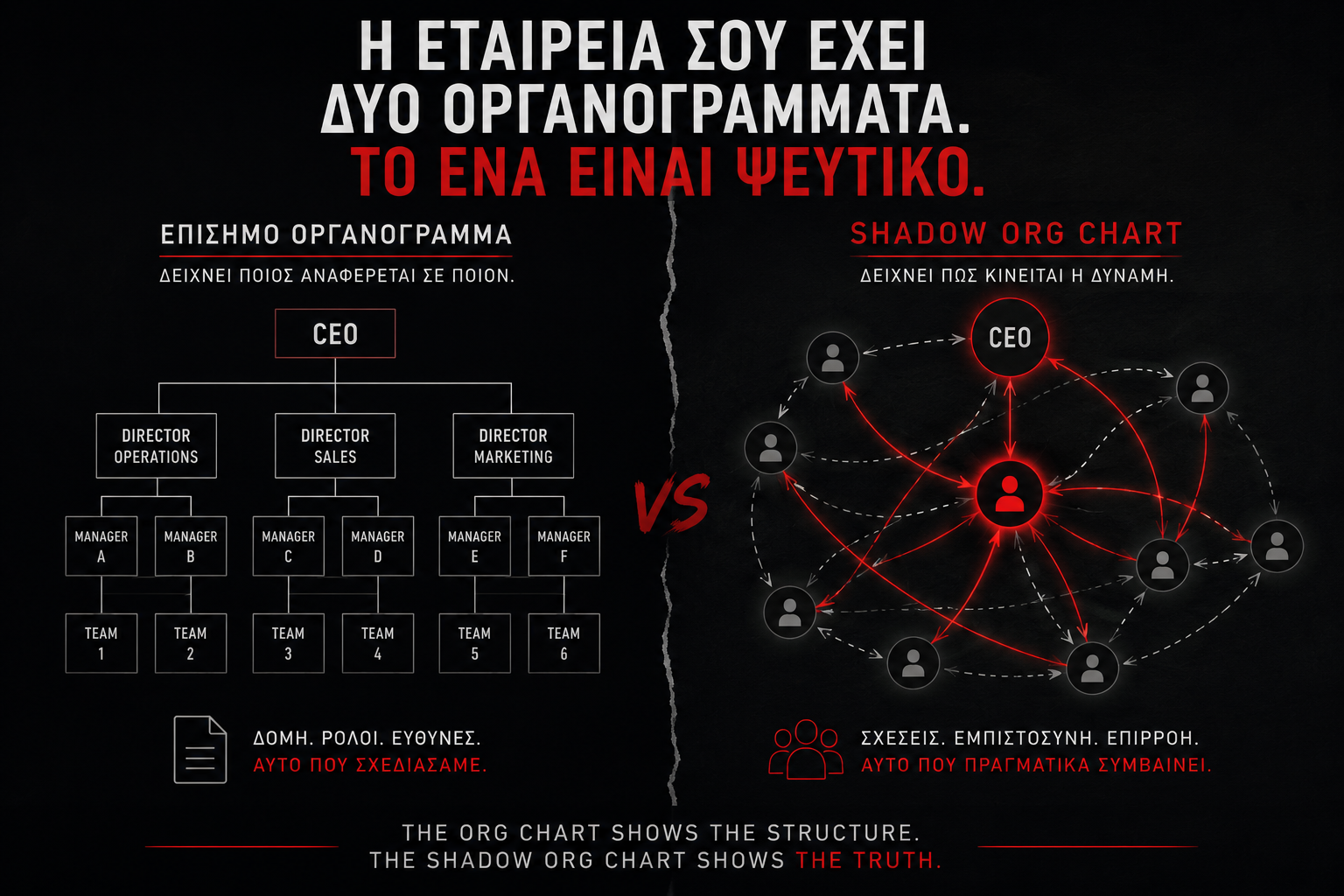
The official org chart shows who reports to whom. The real one shows how power flows.
If you want to truly understand how a company works, do not look at its org chart first. Look at what happens when there is a serious problem.
- • Who do they call?
- • Whose opinion do they seek before making a difficult decision?
- • Who can stop a project without formally having that authority?
- • Who can say “we're moving forward” and suddenly everyone moves forward?
- • And who has an impressive title, but in reality no one waits for their decision?
That is where the real org chart lies. Not in PowerPoint. Not in the HR system. Not in the boxes and lines.
In relationships. In trust. In influence. In access. In the actual flow of decisions.
The Shadow Org Chart
Every company has two organizational structures. The first is the official one: CEO, Directors, Managers, Teams, reporting lines, roles, responsibilities. It is the structure we designed.
But there is also a second one. Invisible. It has not been approved by any board. It appears in no employee handbook. Yet it is often far more powerful than the official one.
It is the Shadow Org Chart: the network of real influence within the organization. Because a title grants authority. Trust grants influence. And the two are not always the same thing.
«Companies are rarely run exactly the way they are drawn.»
| Official Org Chart | Shadow Org Chart |
|---|---|
| Shows who reports to whom | Shows who people really listen to |
| Defined by titles | Defined by relationships |
| Grants authority | Grants influence |
| Describes the structure | Reveals behavior |
| Approved by the board | Appears in no handbook |
| Says “go here” | Says “talk to that person first” |
Three real-world scenarios
Imagine a company where the org chart shows the Commercial Director as having full responsibility for commercial decisions. In practice, however, before every important decision, everyone waits for the opinion of someone who has been with the company for years and has a personal relationship of trust with the CEO. Formally, this person does not decide. In practice, however, they can shift the decision.
In another company, a manager has ten people reporting to him. But when a crisis hits, the team does not go to him. They go to a senior employee without a managerial title. Why? Because he knows. He calms the system. He has credibility. People trust him.
In a third company, a director theoretically has considerable authority. In reality, however, every serious decision requires informal approval from the founder. The box says Director. The system says wait for the founder.
The official org chart describes the structure. The shadow org chart reveals behavior. And when the two are far apart, friction emerges.
That is where the real management problem begins
When apparent authority and actual authority do not coincide, the organization begins sending conflicting signals. The manager believes they make the decisions. The team knows they do not. The senior executive believes they have ownership. But everyone knows there is someone else who can overturn the decision.
The org chart says: “Go here.” The culture says: “Yes, but talk to that person first.”
And that difference creates an invisible tax on the company's speed.
The Invisible Tax
- + More discussions
- + More politics
- + More approvals
- + More “let's see what … thinks”
- − Less ownership
- − Less clarity
- − Less momentum
The Shadow Org Chart is not necessarily bad
Informal structures are not a problem in themselves. In fact, every healthy organization has informal leaders. People who connect teams. People who share knowledge. People who inspire trust without needing a title. These people can be a tremendous asset.
The problem begins when the official system and the actual system move in different directions:
- • When the title says one thing and behavior says another.
- • When you give responsibility without real authority.
- • When you give authority without accountability.
- • When someone exerts enormous influence without anyone recognizing it.
- • Or when a manager has formal authority that the system itself constantly undermines.
Then you do not just have organizational confusion. You have misalignment. And misalignment is friction.
There is also a more difficult question
“If you are a CEO or founder: are you sure you have not created the Shadow Org Chart yourself?”
Because leaders often say they want empowerment — but continue to take direct calls from people three levels below them. They say managers should make decisions — but intervene when they do not like the decision. They say there is a hierarchy — but give greater weight to the opinions of people with whom they have a closer personal relationship.
And without realizing it, they train the entire organization to follow one simple rule:
“Do not look at the org chart. Look at who actually has access to the CEO.”
Then they wonder why managers do not take ownership. Why everyone seeks approval. Why there is politics. Why decisions take so long. The system has simply learned the real rules.
Shadow Org Audit
Draw the second org chart
Not based on titles. Based on behaviors. Ask:
- — Who does the CEO really consult?
- — Who do teams listen to most?
- — Where do decisions concentrate?
- — Who can block an initiative?
- — Who does everyone turn to in a crisis?
- — Who has authority without accountability?
- — And who has accountability without real authority?
If the two org charts look fairly similar, you probably have good organizational alignment. If they look like two different companies, you have just found a significant part of your friction.
The bottom line
Because organizations do not operate the way we design them. They operate according to how people have learned that power actually works within them.
And often, if you want to change the company, you do not need to redesign the org chart. You first need to reveal the invisible.
The org chart shows the structure.
The Shadow Org Chart shows the truth.
FAQ
What is the Shadow Org Chart?
It is the informal, invisible network of real influence within an organization. It is based not on titles and reporting lines, but on relationships, trust, access, and the actual flow of decisions.
Is it bad to have an informal structure of influence?
Not in itself. Every healthy organization has informal leaders who connect teams and share knowledge. The problem begins when the official and actual systems move in different directions.
What are the 5 dimensions of the Shadow Org Chart?
Influence (who people really listen to), Trust (who they turn to when things get difficult), Decision Gravity (who decisions cluster around), Blocking Power (who can stop something), and Crisis Authority (who gains authority under pressure).
What is the cost of misalignment between the two org charts?
It creates an invisible tax on speed: more discussions, more politics, more approvals, less ownership, less clarity, and ultimately less momentum.
How do I conduct a Shadow Org Audit?
Take the official org chart and draw a second one alongside it based on behaviors, not titles. Ask who the CEO consults, who teams listen to, where decisions end up, who can block things, who has authority without accountability, and who has accountability without authority.
Growth Strategy Session
Do you want to see your company's real org chart and reduce friction?
In a Growth Strategy Meeting, we can map where decisions actually concentrate, who has authority without accountability, where initiatives get blocked, and how to realign structure with behavior.
Related Insights
More from the field.
Insight
When ego is present, momentum is lost
How ego acts as friction in leadership.
Insight
Small Teams Need Different Leadership
Organizational Distance and Leadership Resonance.
Insight
Psychological Reactance
Why pressure breeds resistance.
Insight
Causal Reductionism
The single-cause trap in decision-making.