
Decision Making · Critical Thinking
Plausibility vs. Probability: Just because it “makes sense” does not mean it is likely
The most dangerous business story is not the one that sounds absurd. It is the one that sounds perfectly logical.
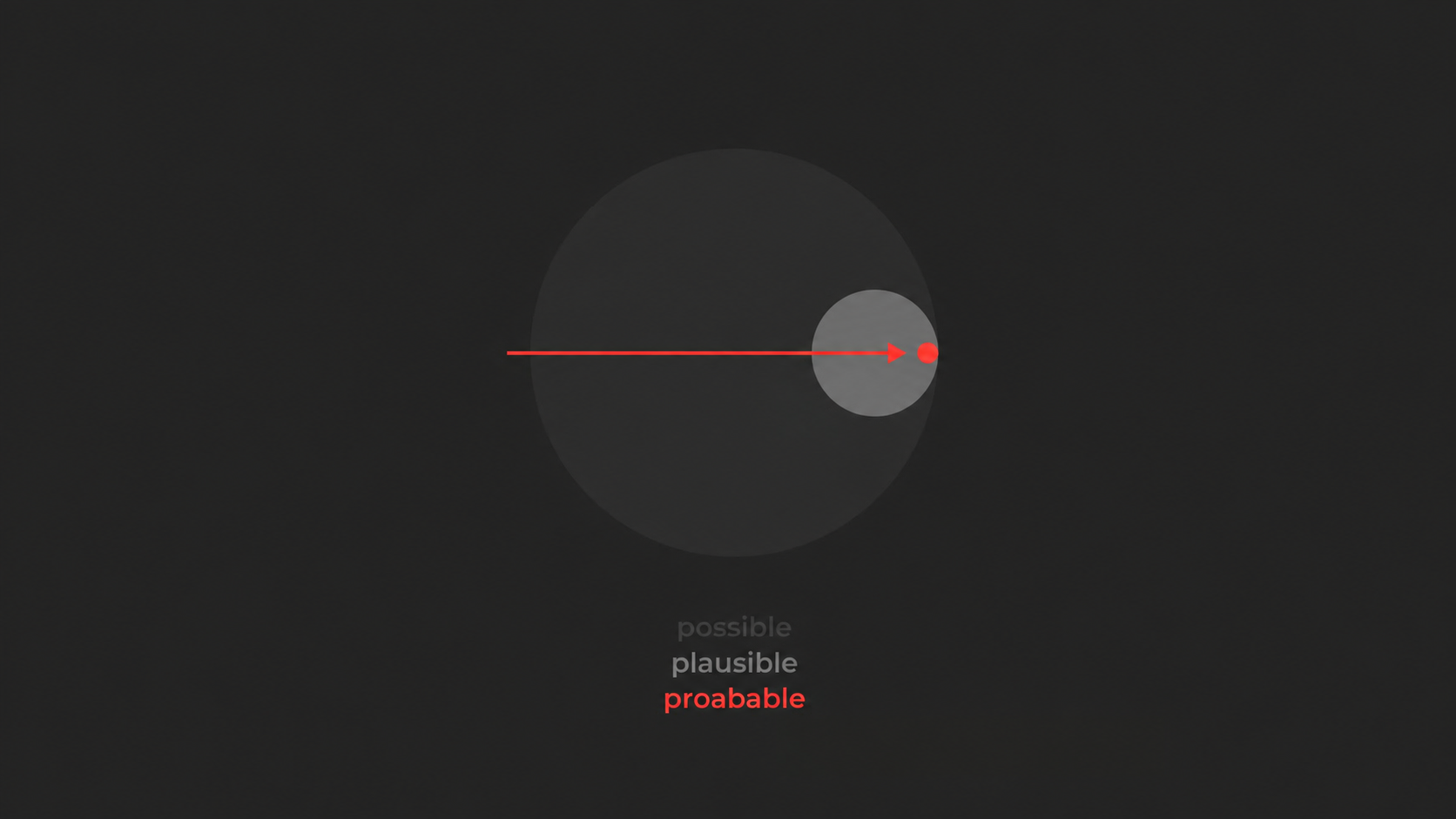
In business, we have a particular weakness for good stories.
- • For a presentation where everything connects.
- • For a forecast with many decimal places.
- • For a strategy with a logical beginning, middle, and end.
- • For an explanation that convincingly answers “why did this happen?”
The more coherent a narrative is, the more we tend to believe it. And the more evidence and detail it includes, the more we feel it is accurate.
But there is a serious problem.
Coherence is not truth.
And precision in presentation does not necessarily mean accuracy in prediction.
Plausible is not the same as probable.
Making this distinction is one of the most important skills in business judgment.
The 3Ps of critical thinking
When faced with an estimate, a business case, an explanation, or a forecast, there are three different levels of thinking.
| Level | In Greek | The question |
|---|---|---|
| Possibility | Possibility | “Can it happen?” — The first filter. It tells us almost nothing. |
| Plausibility | Plausibility | “Does it make sense?” — This is where the trap begins. We feel we have understood. |
| Probability | Probability | “How likely is it really to be the case?” — This is where judgment begins. |
1. Possibility — Possibility
The first question is simple: can it happen? In theory, yes.
- • A competitor may lower its prices.
- • A new product may become a success.
- • An executive may leave.
- • A campaign may double sales.
- • A new customer may become the company's largest account.
But the fact that something is possible tells us almost nothing about whether it will happen. It is simply the first filter.
2. Plausibility — Plausibility
This is where the trap begins. We ask: “Does it make sense?” And we examine whether:
- • the story is logically consistent,
- • the source seems credible,
- • the explanation is simple,
- • there is enough detail,
- • we can easily imagine the scenario happening.
If all of these hold, we feel we have understood the situation. And very often we stop there.
Example
Sales are falling. The sales team says:
“The market has come under pressure, competition has become more aggressive, and customers are delaying their decisions.”
It sounds perfectly logical. It may even be correct. But so far, we have only established that it is plausible. Not that it is the most likely explanation.
Perhaps the real problem lies elsewhere:
- • in lead quality,
- • in pricing,
- • in conversion,
- • in the speed of follow-ups,
- • in the value proposition,
- • or even in a person who has become a bottleneck in the process.
The plausible story gives us the feeling that we have found the answer. Probability requires us to prove that it is indeed the best answer.
3. Probability — Probability
This is where real judgment begins. The question is no longer “Can it happen?” or “Does it make sense?” — but:
“How likely is it really to be the case?”
This changes the conversation entirely.
- — A sales forecast may look exceptionally well structured. But how many assumptions must hold true simultaneously for it to be achieved?
- — A new business idea may look excellent in PowerPoint. But what is the probability that product-market fit, pricing, acquisition, distribution, and execution will all work simultaneously?
- — A decline in an executive's performance may be attributed to a lack of motivation. But how much do we really know about the factors that may have caused it?
- — A campaign may be projected to increase sales by 30%. But what must remain constant for that to happen?
That is where we begin to see something important: many scenarios are highly plausible when we narrate them — and far less probable when we take them apart.
The problem of hidden assumptions
Every business story is made up of assumptions. We simply do not usually see them.
Let us say we are planning a new product and estimate that it will generate €1 million in new revenue. For that to happen, it may require:
- • the market to grow,
- • the price to be accepted,
- • the campaign to deliver,
- • the sales team to achieve a specific conversion rate,
- • production to meet demand,
- • existing customers not to be cannibalized,
- • and competition not to respond aggressively.
Each assumption on its own may seem logical. The problem is that we do not need each one to be logical in isolation. We need several of them to happen together. And that is where the overall probability can drop dramatically.
The illusion of precision
The cell reads:
€1.037.420
and the number looks scientific. In reality, it may rest on six assumptions that no one has seriously examined.
Numerical precision does not resolve uncertainty in the assumptions.
Where the quality of a decision lies
Good judgment is not the ability to create convincing explanations. People are excellent at that.
Good judgment is the ability not to fall in love with the first story that explains the data. To keep a little space between:
Plausible
“This makes sense.”
Probable
“This is likely to be true.”
Much of the quality of a decision lies in that small space.
Because in business, we are not paid to construct the most coherent stories. We are paid to make better decisions under uncertainty.
And perhaps one of the most useful questions a leader can ask before approving a strategy, a forecast, or a major investment is this:
“Fine. It is plausible. But how probable is it?”
That is where storytelling stops.
And judgment begins.
FAQ
What is the difference between plausible and probable?
Plausible means that a story is logically consistent and makes sense. Probable means that there is actual evidence showing that it is the best explanation. Coherence is not truth.
What are the 3Ps of critical thinking?
Possibility: can it happen? Plausibility: does it make sense? Probability: how likely is it really to be the case? Most teams stop at the second level.
Why does a detailed forecast create an illusion of certainty?
Because numerical precision looks like scientific precision. A cell displaying €1,037,420 may rest on six assumptions that no one has seriously examined. Precision in presentation does not resolve uncertainty in the assumptions.
What three questions should I ask before believing an explanation?
Which assumptions must be true for it to hold? How likely is each one to hold? What changes if one of them is wrong? The third reveals how fragile the decision is.
Why do multiple assumptions reduce the overall probability?
Because it is not enough for each one to be logical on its own — several need to happen together. When a scenario depends on six or seven simultaneous assumptions, the overall probability drops dramatically.
Growth Strategy Session
Do you want to test the assumptions behind your next big bet?
In a Growth Strategy Meeting, we can take the business case apart, make the hidden assumptions explicit, and see how fragile or resilient the decision is.
Related Insights
More from the field.
Insight
Causal Reductionism
The single-cause trap in decision-making.
Insight
Do not decide on the details before the direction
Decisions with a multiplicative impact.
Insight
The trap of obvious problems
Survivorship bias and the Reverse Check.
Insight
The trap of “smart incentives”
When the metric improves and the truth gets lost.