
Leadership · Executive Maturity · Growth Igniter
Personality opens doors. Character keeps you inside.
You are not defined by what you say about your values, but by what you choose when the right decision comes at a cost. Personality opens doors. Character decides what you will do once you walk through.
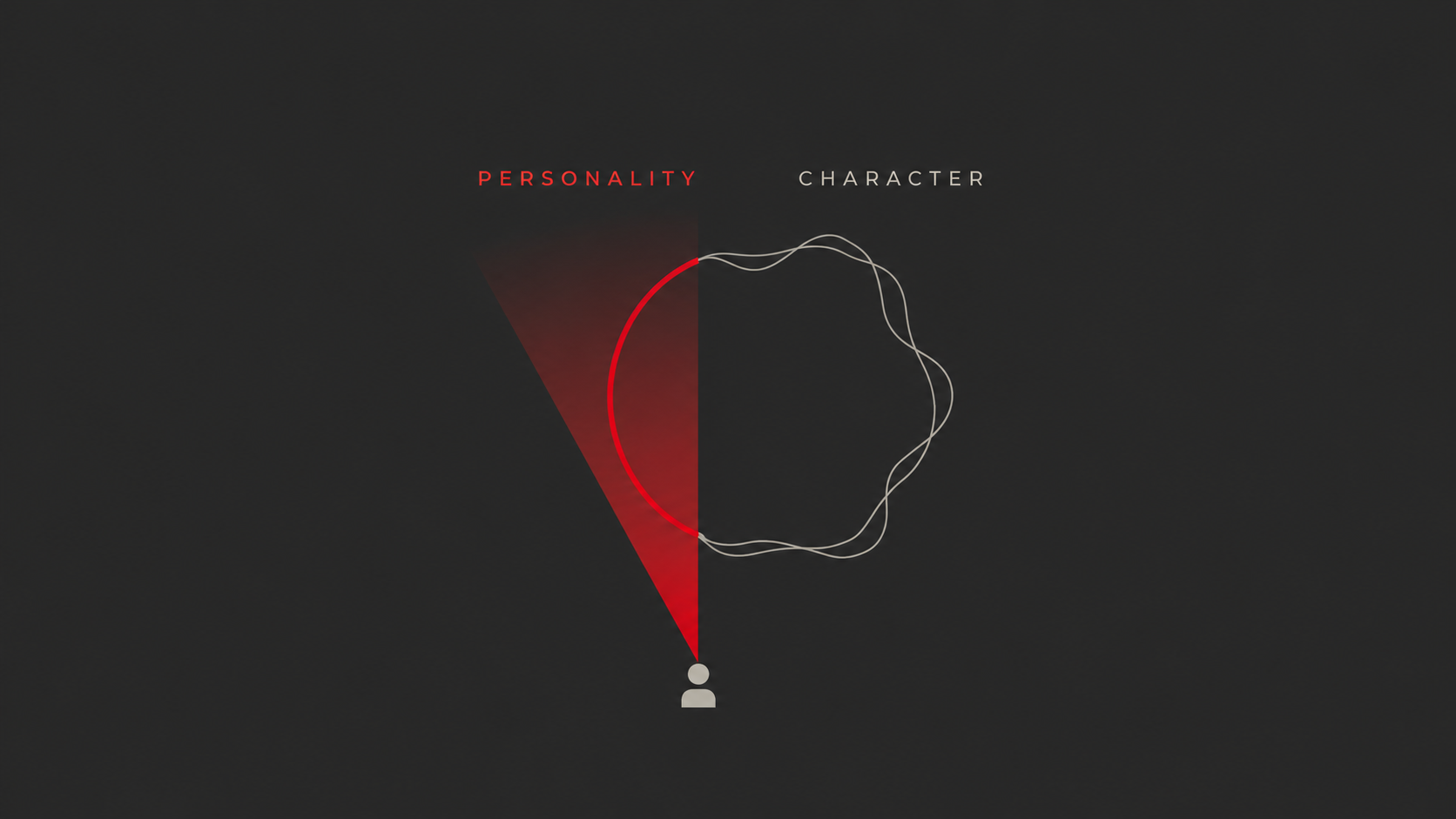
We live in the age of visibility.
Our presence is constantly being evaluated.
The way we speak. Our profile. Our confidence. The image we create in a room, in an interview, in a meeting or on LinkedIn.
And all of this matters.
Personality can capture attention.
It can make people like us.
Open doors.
Persuade people to listen to us.
But there is a limit to what image can achieve.
Because at some point, the impression ends.
And that is when the proof begins.
Personality is the interface. Character is the operating system.
Personality is the way we show up in the world.
It includes our style, our communication, the energy we project, our social intelligence, humor, charm and ability to influence others.
Character lies deeper.
It is the value system that determines what we do when:
- the right decision is difficult,
- the truth comes at a cost,
- no one is going to reward us,
- we have the power to choose the easy option,
- we can avoid the consequences.
Personality shapes the first impression.
Character shapes the final judgment.
Leadership is revealed under pressure
It is easy to present yourself as a fair leader when everything is going well.
Your character shows when you must decide who will take responsibility for a failure.
It is easy to talk about transparency when the news is positive.
Your character shows when you must convey a difficult truth to the board, your people or your clients.
It is easy to say you believe in your colleagues.
Your character shows when someone makes a serious but honest mistake.
It is easy to talk about culture, respect and trust.
Your character shows when you have the power to bypass everything you proclaim.
Pressure does not create character.
It reveals it.
The dangerous gap between image and reality
A strong personality without matching character creates a dangerous gap.
- A leader may be charismatic but unreliable.
- They may inspire in a presentation but avoid difficult decisions.
- They may talk about people but treat them as expendable when the numbers put them under pressure.
- They may project confidence but punish every voice that disagrees with them.
At first, personality covers this gap.
Not forever.
People notice recurring patterns.
Teams remember contradictions.
The market recognizes the difference between the promise and the actual experience.
“What you are shouts so loudly in my ears that I cannot hear what you say.”
Ultimately, our words do not define us.
We are defined by the source from which our actions stem.
The five tests of character
Character is not proven through statements of values.
It is proven through repeated choices.
01
The pressure test
How do you behave when results fall short of expectations? Do you take responsibility or look for someone to blame?
02
The cost test
Do you remain true to your principles when that choice costs you money, time, popularity or personal security? A principle without a cost is merely a preference.
03
The power test
How do you treat people from whom you need nothing? Power does not necessarily change a person. Often, it simply removes the constraints that forced them to pretend.
04
The test of no recognition
Would you do the right thing even if no one ever found out? Personality needs an audience. Character does not.
05
The consistency test
Do your principles remain the same when circumstances, people or your interests change? Character is not one impressive moment. It is a consistent pattern.
Character is business capital
We often treat character as a moral or personal matter.
In reality, it is also a business asset.
- Character creates trust.
- Trust reduces the need for excessive control.
- Less control reduces organizational friction.
- Lower friction accelerates decisions, collaboration and execution.
In this sense, character does not sit outside a company's growth system.
It sits at its core.
An organization whose people do not trust its leadership is forced to spend enormous amounts of energy on self-protection.
- Employees watch what they say.
- Managers avoid taking risks.
- Information is filtered.
- Problems are hidden until they become crises.
- Decisions are delayed until there is political cover.
A lack of character at the top turns into friction throughout the system.
Personality is not the enemy
The point is not to undervalue personality.
Communication, presence, confidence and the ability to influence are important leadership skills.
- A leader must be able to convey a vision.
- Create energy.
- Connect with people.
- Give meaning to the effort.
The problem begins when personality is used as a substitute for substance.
When leaders invest more in how they appear than in who they are becoming.
When the narrative consistently runs ahead of reality.
When a personal brand becomes a performance rather than a reflection of genuine principles.
The strongest image is one that does not need to be artificially maintained.
Because it is based on something real.
From personal brand to personal truth
Your personal brand is not what you declare yourself to be.
It is the meaning created by the consistency between what you say, what you decide and what you tolerate.
It is not built through content alone.
It is built when:
- you keep a difficult promise,
- you tell the truth before it becomes convenient,
- you protect someone without personal gain,
- you take responsibility without spreading the blame,
- you remain consistent when inconsistency would be easier.
Reputation is what people believe about you.
Character is what remains when reputation is stripped away.
Do not try to appear. Become.
Personality can help you win an opportunity.
Character will determine what you do with it.
Personality can create followers.
Character creates people who trust you.
Personality can make you visible.
Character makes you credible.
And in leadership, credibility matters more than impression.
Because people may be impressed by what you say.
But they will act only when they trust who you are.
Don’t portray. Be.
Theodore Georgedakis · The Growth Igniter
Nothing ignites on its own.
Growth Strategy Session
Want to see where your leadership rests on personality and where it rests on character?
More Insights
More from the field.
Insight
When ego is present, momentum is lost
Ego as friction in leadership and disciplined clarity.
Insight
If you want decision-makers, you must accept decision mistakes
Autonomy, accountability and the framework at three levels.
Insight
Where control meets concern
Where your energy is truly worth directing.