
Leadership · Strategic Maturity
Both are true. Now what?
Strategic maturity begins when one truth stops becoming an excuse to ignore the other.
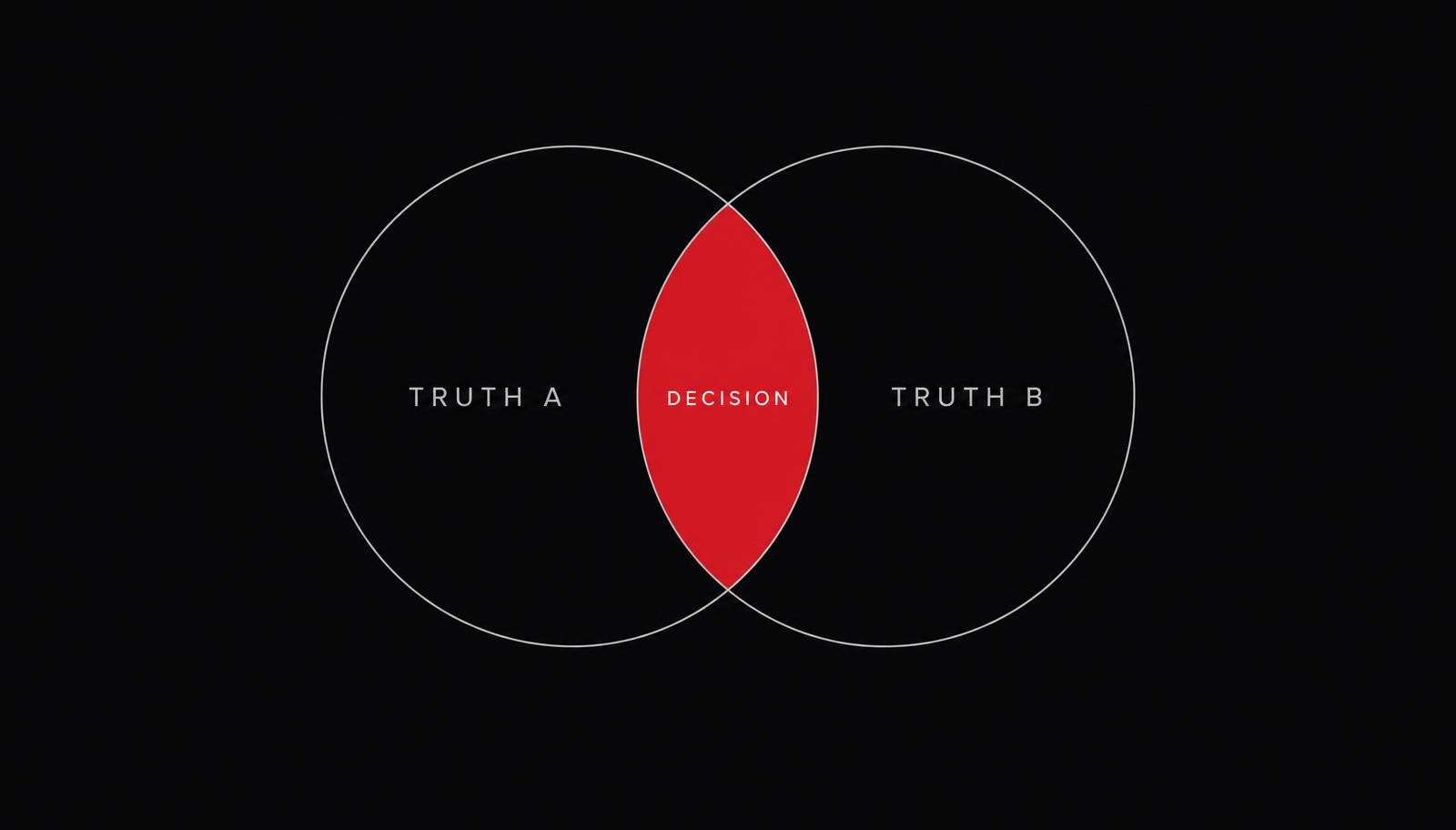
Half the truth can become the whole problem.
A business can make a very bad decision based on something entirely true. All it takes is to treat it as the only thing that holds true.
That is why I believe an organization's most important capability is being able to hold two opposing truths at the same time.
Not to consider every opinion correct. Nor to avoid difficult choices with a convenient “it depends.”
To recognize that two realities can coexist, even when they pull it in different directions. And to decide without erasing the one that makes things difficult.
This sounds simple until a budget needs to be allocated, a role changed, or authority limited.
At that point, the discussion can easily stop being solely about what the business needs. It is also about who will be vindicated. Which previous decision will be challenged. Who will need to admit that their perspective, however correct, is not enough.
The difficult part is not always recognizing that you are wrong. It is recognizing that being right does not mean you hold the whole truth.
Let us look at this in three business situations.
| Area | Truth A | Truth B |
|---|---|---|
| Customization | Creates real value and competitive advantage. | When unlimited, it hinders growth and operations. |
| Founder | Has the best judgment and spots risks first. | His mandatory involvement in every decision slows everything down. |
| A person with a history | His past contribution is real. | The current performance gap is also real. |
1. What made us successful is starting to constrain us
Think of a service company that has grown by adapting everything to each customer's needs.
Its flexibility is a genuine competitive advantage. Customers feel that someone understands them and finds solutions where others say “that cannot be done.”
As the company grows, however, every new customer adds different processes, exceptions, and arrangements. Delivery depends on a few people who know all the particularities. Revenue grows, but so does the difficulty of running the business, disproportionately.
Truth A
Customization creates value.
Truth B
Unlimited customization prevents growth.
The easy response is either to defend “this is how we succeeded” or to impose standardization that eliminates the very thing people choose you for.
The more demanding task is to distinguish where adaptation creates value for the customer and where it simply creates cost for the company.
- • To build a shared way of working.
- • To define which exceptions you accept.
- • To price those that require genuinely different service.
This may mean you will not win every project. It is a cost you need to choose consciously, rather than paying it silently with every delivery.
Past success was not a mistake. The mistake would be to assume that the approach that produced it remains appropriate at any scale.
2. The founder is the greatest advantage. And the main constraint.
In a growing business, the founder may indeed have the best judgment. He knows the customers, understands the product, and identifies risks others do not yet see.
At the same time, the requirement that everything go through him may have become the reason nothing moves fast enough.
The quality of his judgment helps the company. His mandatory involvement in every decision limits its ability to operate.
If he holds on to only the first truth, dependence will continue to be presented as “quality assurance.” If he holds on to only the second and withdraws abruptly, he will transfer responsibility without having transferred criteria.
The solution requires something harder than “I need to trust more”: making his knowledge usable by others. Clarifying which decision belongs to whom, which boundaries must not be crossed, and when his intervention is needed.
And then accepting decisions he would not have made in exactly the same way, but which fall within the agreed boundaries.
A company does not gain autonomy as long as every different judgment is treated as a mistake the founder must correct.
3. Our team member deserves support. And his performance is not sufficient.
Take someone who has contributed a great deal to the business. He is dependable, makes an effort, and has stood by the team through difficult periods.
His role, however, has changed. Demands have grown, and his results no longer meet them.
His past contribution is real. So is the current performance gap.
If management recognizes only the contribution, it may avoid the conversation and shift the burden to others. If it recognizes only the gap, it risks treating the person as though today's difficulty cancels out his entire track record.
Holding both truths means having a clear conversation: what the role requires, what is missing, what support will be provided, and when progress will be assessed.
Improvement may follow. A change of role may be needed. Care does not guarantee that everything will continue as before.
Respect for the person does not negate the requirement for results. It determines how you handle it.
You do not always need a compromise. You need a complete decision.
The common thread in these examples is not “balance.” There is no magic ratio that satisfies everyone and makes the cost disappear.
Sometimes you need to clearly prioritize one side. To limit customization. To leave a decision to the team. To change a role.
The difference lies in whether you know what you gain, what cost you accept, and which boundary you are unwilling to cross.
That is why, in the next management discussion, it is worth adding one question before the decision is finalized:
“Which truth are we at risk of ignoring because the other suits us better?”
And the answer needs to change something specific: a boundary, a responsibility, an evaluation criterion, or the timing of a review. Otherwise, we have simply acknowledged the contradiction without managing it.
An organization's maturity begins when it no longer needs to ignore half of reality to make a clear decision.
FAQ
What does it mean to hold two opposing truths at the same time?
It means recognizing that two realities can coexist, even when they pull in different directions — and making a decision without erasing the one that makes things difficult for you. It does not mean that every opinion is right, or that you avoid a difficult choice with a convenient “it depends.”
Why does adapting to the customer eventually become a constraint?
Because every new customer adds different processes and exceptions. Customization creates value, and unlimited customization prevents growth. The task is to distinguish where adaptation creates value for the customer and where it simply creates cost for the company.
How do you reduce dependence on the founder without losing quality?
By making his knowledge usable by others: which decision belongs to whom, which boundaries must not be crossed, and when his intervention is needed. And then accepting decisions he would not have made in exactly the same way, but which fall within the agreed boundaries.
How do you manage someone who has contributed but is no longer performing?
With a clear conversation: what the role requires, what is missing, what support will be provided, and when progress will be assessed. Respect for the person does not negate the requirement for results — it determines how you handle it.
What question is worth asking before a management decision is finalized?
“Which truth are we at risk of ignoring because the other suits us better?” And the answer needs to change something specific: a boundary, a responsibility, an evaluation criterion, or the timing of a review.
Growth Strategy Session
Which truth is your business ignoring today because the other suits you?
In a Growth Strategy Meeting, we put both truths on the table and reach a complete decision: a boundary, a responsibility, a criterion, and a review time.
Related Insights
More from the field.
Insight
Plausibility vs. Probability
Just because it “makes sense” does not mean it is likely.
Insight
Do not decide the details before the direction
Decisions with a multiplier effect.
Insight
Your company has two organizational charts
Shadow Org Chart and real influence.
Insight
When ego is present, momentum is lost
Ego as friction in leadership.