
Strategy · AI · Productivity
Greece’s Next Economic Crisis Will Not Be Economic or Political.
The productivity crisis is a momentum crisis. Why growth in Greece depends on reducing friction, alignment, and redesigning operations with AI.
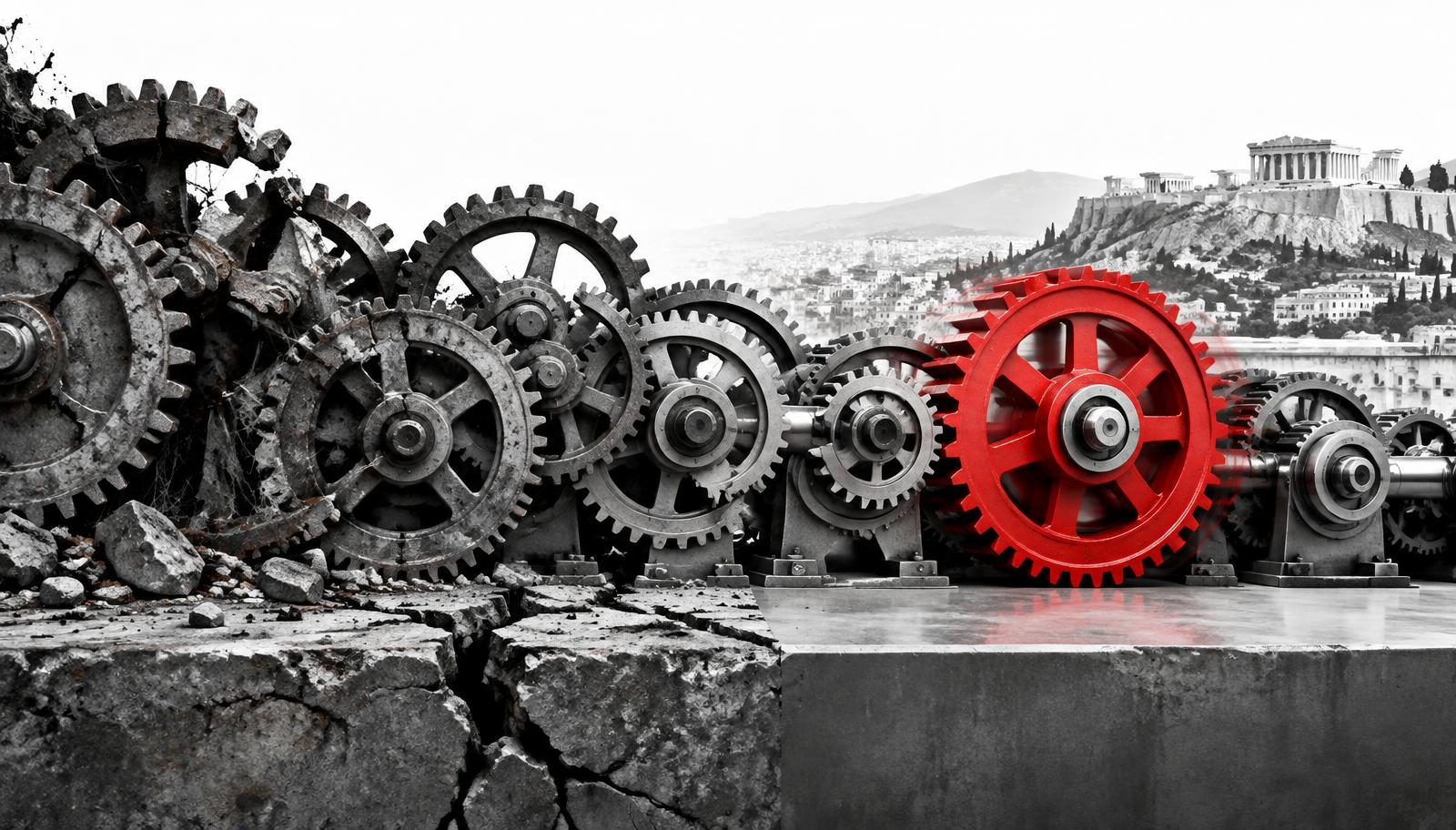
For a decade now, we have been expecting the next crisis to come from the wrong direction. We look for it in inflation, in the markets, in geopolitics, in the next trade war. We scan the horizon for the storm and fail to notice that the ground beneath our feet has already begun to give way.
The next crisis that will define a small, open economy like Greece's will not be economic. Nor political. It will not arrive with a siren, it will not make the front page, and it will neither be brought on by one government nor solved by another. It will come from within, from the way our businesses work. And it is already here.
We call it a productivity crisis, and that is its most polite name. In essence, it is a momentum crisis. And momentum is not lost through a lack of effort. It is lost through friction.
For years, we based growth on two things: consumption and public spending. Both have reached their limits. Disposable income is under pressure, inequalities are widening, and the consumer base is stagnant. Meanwhile, the population is aging. Europe is aging, Greece is aging faster, and the skills the new economy demands are not easy to find in the market. Fewer people are being asked to produce more value, using tools built for a world that no longer exists.
Only one real lever of growth remains. Productivity. The only way to raise living standards without artificial injections of demand and without new inflationary cycles.
Let me put it in the terms I have been working with over the past few years, through the momentum equation:
Momentum = (Useful Energy − Friction) × Alignment
Look at what demographics do to this equation. They reduce Useful Energy. Fewer hands, fewer hours, fewer available skills. The first variable is drying up, and wishful thinking will not bring it back.
What do most businesses do in response? They push harder. More hours, more effort, more pressure on the same people. They try to gain momentum by straining a variable that is already running out. They work harder. Not smarter. The result is predictable: wear and tear, costs, shrinking margins, people leaving.
If Useful Energy is falling, growth can be found in only two places. In reducing Friction and increasing Alignment. That is where productivity lives. Nowhere else.
This is where artificial intelligence comes in. Not as “yet another technology.” As a workforce, and above all as a lever that acts exactly where the equation hurts. On friction. It takes over repetitive processes. It produces analyses in timeframes that were previously unimaginable. It speeds up decisions. It frees people from work that humans should never have had to do.
And yet, in most businesses, the result is negligible. Not because the technology failed. Because they put it in the wrong place.
The biggest mistake is the same one, repeated everywhere. We digitize our friction. We take a tired, old process and put a chatbot on top of it. We automate the problem instead of eliminating it.
Why does it not work? Because friction does not live within departments. It lives between them. At the points where information passes from one hand to another, where it waits for approval, where context is lost, where no one has the full picture. A chatbot on top of a broken flow does not fix the flow. It simply makes it broken faster.
Technology alone saves no one. Redesign does. You do not need a tool that answers. You need a system of agents that work together. You do not need a pool of data. You need infrastructure that produces decisions in real time. You do not need training in tools. You need a change in the logic by which you make decisions. The businesses that stand out will not be those that “added AI.” They will be those that redesigned the way they operate around what machines can now do.
And then the equation turns in the right direction. Friction falls. Speed rises. Errors decrease. People move into higher-value roles, which means each person's Useful Energy increases, even when there are fewer people. This is not “improvement.” It is momentum. And momentum against a competitor who is still experimenting is an advantage that is not easily overcome.
For Greece, the challenge is twofold. The largest part of our economy, small and medium-sized businesses, starts from low productivity. That is the bad news. The good news is that, with the right guidance and incentives, adoption happens quickly. A business starting from a low base has more friction to cut, and therefore more room for a leap forward. The window will not stay open forever. We are talking about two years, not ten. And every year the country ages, the equation becomes harder.
Economies, like businesses, rarely collapse with a bang. They lose momentum. Slowly, quietly, until friction exceeds the energy they have left. Then the equation turns negative, and you realize it far too late.
The productivity crisis does not make the front page. It has no siren. It appears as a persistent, mild pressure until it becomes a dead end. The next financial crisis may take time to arrive. The momentum crisis is already at the door. And it is not a question of “if” it will come. It is a question of who will reduce their friction before reality forces them to.
Nothing ignites on its own.
Theodore