
Leadership · Decision Making · Growth Systems
The Trap of “Obvious” Problems: The Lesson of Abraham Wald.
Leaders often reinforce whatever seems to hurt. But the truly critical points are often those that never appear in reports.
In management, we tend to focus on whatever “shouts.” On the complaints we hear. On projects that are delayed. On sales that were lost. It is logical — but it is also dangerous.
The real threat to a business often lies not in visible damage. It lies in the silent points of failure: where the system collapses before anyone has a chance to study it. To understand this, we need to go back to one of the best-known lessons in decision-making: World War II.
Key Takeaways
- — Not all visible problems are the most critical problems.
- — Survivorship bias means studying only what has “returned” and ignoring what was lost.
- — Leaders often improve areas that are already surviving.
- — The most dangerous business blind spots are those that do not appear in reports.
- — The quality of decisions depends on what you choose to study.
- — The “Inverse Audit” helps teams find silent points of failure.
The Example of Abraham Wald
During World War II, analysts studied aircraft returning to base from missions, aiming to reduce losses from enemy fire. They recorded the points where the planes had been hit and proposed adding armor to those very areas. That makes sense, right?
Abraham Wald — a mathematician who contributed to decision theory, econometrics, and statistical sequential analysis — pointed out that this would be a mistake. The study concerned only aircraft that had survived their missions. Even after being hit, they had managed to return.
So the points with visible damage were not necessarily the most vulnerable. They were the points where an aircraft could be hit and survive. By contrast, planes hit in the engines or cockpit probably never returned to be studied. Wald's proposal was to focus on the points without visible damage on the returning aircraft. Those were probably the fatal points.
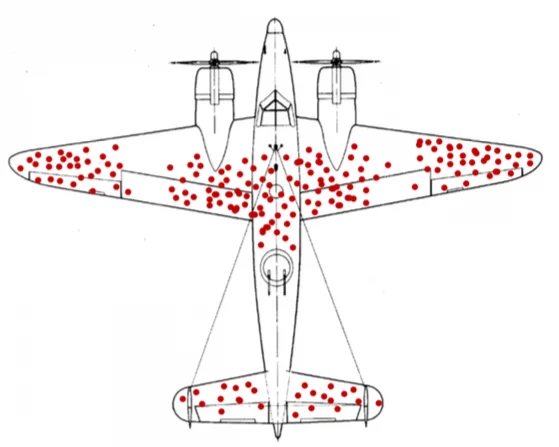
What Is survivorship bias in Plain Language
Survivorship bias is the mistake of drawing conclusions only from what has returned to the system — and ignoring what was lost along the way. In business, this translates into a very specific problem: your reports show you only what survived long enough to be measured.
The visible symptom is not always the root of the problem. Some failures disappear before they become data. Whatever ultimately reaches the meeting table has already been filtered — by memory, by hierarchy, by fear, by the previous quarter's priorities.
“The most dangerous problem in a team is the one that never reaches the table.”
Why this matters for leaders
Leaders often confuse noisy problems with important ones. A department that complains loudly is not necessarily the department most at risk. A customer who sends emails with demands is, ironically, a customer who is still staying. What has no voice is what has already left.
Successful businesses have no magic filter or formula. They make better decisions — or, more precisely, avoid the wrong decisions at critical points. Better strategy rarely starts with more data. It starts with better questions.
The 3 Steps of the Inverse Audit
1. Look beyond the visible signs
When a department runs “like clockwork,” the team celebrates. But stability is not the same as resilience. Success often simply conceals systemic weaknesses that have not yet been hit. The question is not “what works,” but: if it collapsed tomorrow, what would be the cause?
2. Look for the “missing planes”
Do not study only the customers who stayed or the projects that succeeded. The richest insights lie in those who quietly left, in leads who never responded, in people who resigned without complaining, in ideas that never reached execution. Decision quality improves when you start studying absences, not just incidents.
3. Reinforce decision-making, not just the outcome
The outcome is visible. The decision that produced it is not. When you reinforce only outcomes, you build defenses around symptoms. When you reinforce decisions — with criteria, with escalation rules, with a regular cadence for studying absences — you improve the quality of the system. Growth is not just about adding energy. It is primarily about reducing hidden friction.
The 30-Second Micro-Move: The Silent Death Question
At the next strategy meeting, ask the team one simple question:
“What is the one thing that, if it fails, we will not even have time to discuss at this table?”
This question forces the team to stop looking only at visible problems and start identifying silent points of failure. It shifts the discussion from “what is making noise?” to “what is existential?”.
Examples by Function
The same mechanism appears in every business function — only the form of the “missing planes” changes.
Sales
Sales
Do not look only at why a deal closed. Look at why 80% of leads never responded to you. These are your “missing planes” — and they usually hold the most useful information about positioning, timing, and the value proposition.
Product
Product
Do not improve only the features that power users use. Investigate why everyone else never opened the app, or opened it once and never returned. That is where the real onboarding gap lies.
HR / Culture
People & Culture
Do not listen only to those who speak up in surveys. Analyze why the most talented people resign without ever complaining. The most dangerous loss is the one that does not even make a sound on the way out.
Operations
Operations
Do not examine only the delays that appeared in reports. Look at the handoffs that were never recorded but create silent friction every week — that is where the cost of doing business accumulates.
Marketing
Marketing
Do not analyze only the campaigns that visibly failed. Look at the messages that never prompted a response, the audiences that did not act, the leads that never became conversations. Audience silence is data too.
Finance
Finance
Do not look only at large variances. Look at the small, recurring patterns that indicate cash flow, forecasting, or margin is under silent pressure. Major crises rarely start as large numbers.
Wrong Question vs Better Question
The quality of a leader's decisions starts with the quality of their questions. Below are three pairs — the same topic, different strategic visibility.
| Bad leadership question | Better leadership question |
|---|---|
| “Where do we have the most complaints?” | “Who never complained, but left?” |
| “Which project was delayed the most?” | “Which project never started because the system blocked it before it became visible?” |
| “Which campaign failed?” | “Which audience never responded — and therefore never even gave us feedback?” |
The Inverse Audit Checklist
Ten questions for the next leadership offsite. Not to answer them all — but to reveal which ones do not even have an owner within the team.
- 1. What are we studying because it is visible?
- 2. What are we not studying because it never returned to the system?
- 3. Which customers left without a complaint?
- 4. Which leads disappeared before becoming opportunities?
- 5. Which projects never started?
- 6. Which talented people left without speaking up?
- 7. Which points in the funnel have no feedback?
- 8. Which function seems stable but would be fatal if it collapsed?
- 9. Where are we making decisions based only on the “survivors”?
- 10. Which decision would reinforce the system before the damage becomes visible?
“Success does not always lie in what you see. It often lies in what is missing from the picture.”
Frequently Asked Questions
What is survivorship bias in management?
Survivorship bias in management is the tendency to draw conclusions only from what has “returned” to the system — customers who stayed, projects that succeeded, employees who spoke up — and to ignore what was silently lost. As a result, decisions are based on a partial sample of reality, and the most critical blind spots remain invisible.
Who was Abraham Wald, and why is his example important?
Abraham Wald was a mathematician who contributed to decision theory, econometrics, and statistical sequential analysis. During World War II, as part of analyses of aircraft returning from missions, he pointed out that armor should be added where the returning planes had no damage — because planes hit in those areas had probably never returned. It is the clearest example of survivorship bias in decision-making.
How does survivorship bias affect decision-making in a business?
It leads leaders to reinforce areas that are already surviving, rather than areas where the system is silently failing. Execution thus appears rational — data-driven — but the data is filtered. The most fatal weaknesses do not appear in reports because there is no one to report them.
What is the Inverse Audit / Inverse Audit?
It is a three-step framework that helps the team study not only what appears, but also what is missing: 1) Look beyond the visible signs, 2) Look for the “missing planes,” 3) Reinforce decision-making, not just the outcome. Its aim is not paranoia, but strategic visibility.
How can a CEO or founder identify the “missing planes” in their business?
By systematically studying absences: leads who never responded, customers who left without a complaint, talented people who resigned without a discussion, projects that were blocked before they became visible, messages that prompted no response. These absences are often more instructive than success reports.
What question can reveal a team's most dangerous blind spots?
“What is the one thing that, if it fails, we will not even have time to discuss at this table?” This question shifts the discussion from noisy problems to existential ones — from visible symptoms to silent points of failure.
Growth Strategy Meeting
Do You Want to See the Problems That Never Reach the Table?
If your team is constantly solving the obvious problems but execution still gets stuck, you may be looking at the wrong part of the system. In a Growth Strategy Meeting, we can map the visible symptoms, the hidden points of friction, and the decisions you need to reinforce before they become critical.
The best decisions do not always start with more data. They start with better questions.