
Strategy · Scaling · Momentum
The sequence Fibonacci as a business management system.
Growth is engineered, not guessed. The Fibonacci sequence as an architectural system for growth management.
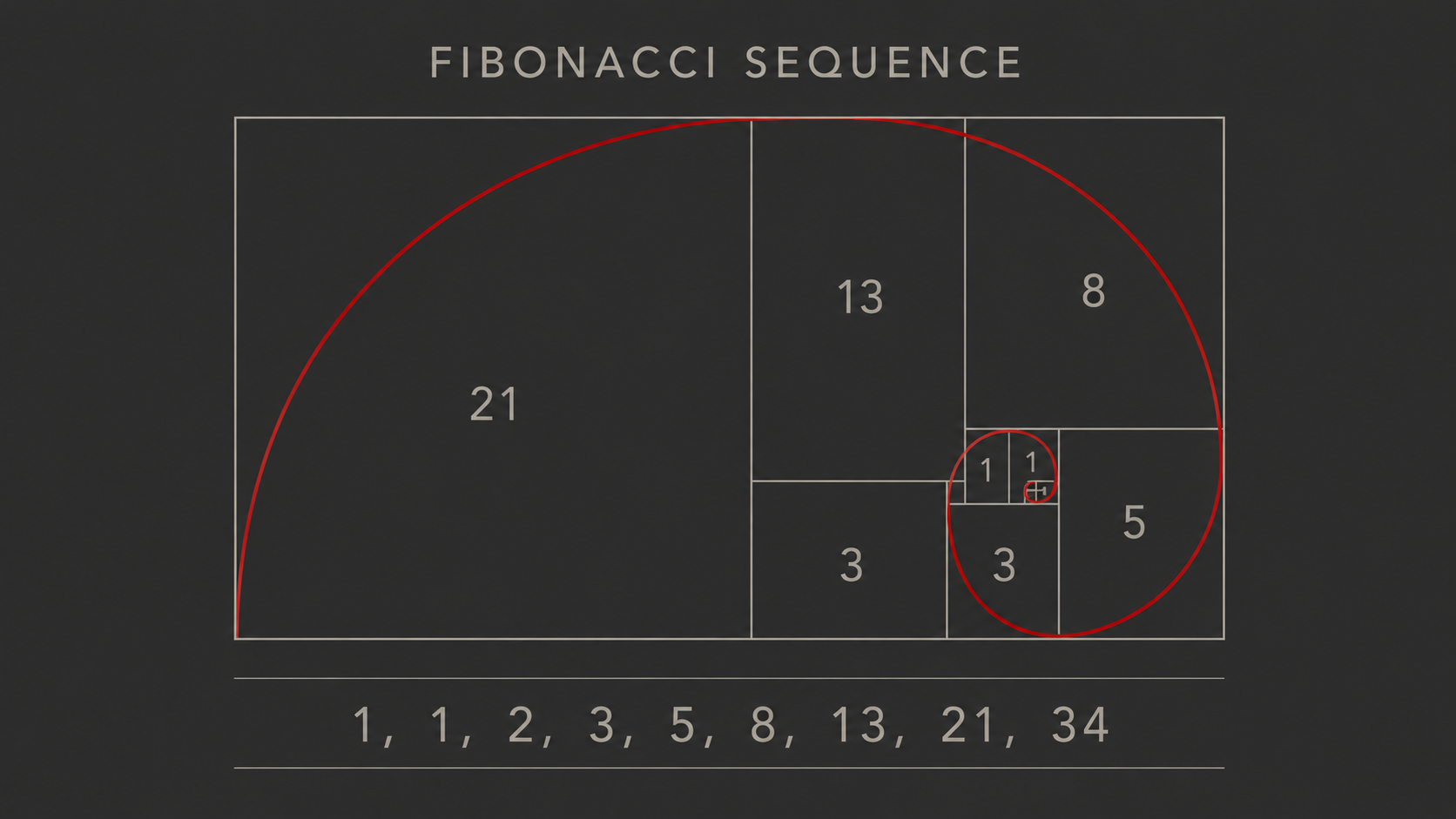
Why do some businesses grow through natural scaling, while others grow through noise, fatigue and internal collapse?
The Fibonacci sequence — 1, 1, 2, 3, 5, 8, 13, 21… — is not just a numerical pattern. It is a way to think about growth as successive synthesis. Each new level does not appear out of nowhere. It emerges from the previous two.
Fₙ = Fₙ₋₁ + Fₙ₋₂
Translated into management: the next stage of a business's growth must be built on current capability and the institutionalized learning of the previous stage.
The Momentum Equation answers: what creates motion? Fibonacci answers: in what sequence does motion scale without breaking the system?
1. The fundamental management principle: growth without sequence is "noise"
Many businesses fail because they try to go from 2 to 21. They want:
- • to double revenue before stabilizing positioning,
- • to open new channels before the first one works,
- • to build a team before clarifying the operating model,
- • to introduce AI before they have a clear strategy,
- • to increase marketing spend before fixing conversion and delivery.
A business cannot move to the next level unless it has "assimilated" the previous two.
2. The Fibonacci Management System
A business growth system where each successive stage of scale is built by combining current operational capability with previously institutionalized learning.
Next Growth Level = Current Capability + Institutionalized Learning
If the business does not retain learning, it will grow painfully. It simply repeats the effort to grow. This explains why many SMEs remain exhausted while constantly “running.” They have energy, but they do not have recursion. Each project starts almost from scratch. Each campaign repeats old mistakes. Fibonacci imposes organizational memory.
3. The 7 principles of Fibonacci in management
4. The Fibonacci Growth Ladder
An 8-level management model that respects the order of the sequence.
| Level | Stage | Executive question |
|---|---|---|
| 1 | Strategic Intent | What is the one thing that, if it moves over the next 90 days, will change the energy of the entire company? |
| 1 | Operating Reality | Where are we really: where is time being lost, where do handoffs break down, which KPI hides a problem? |
| 2 | Strategic Choice | Which segment comes first, which project stops, which market are we not pursuing yet? |
| 3 | Core Engines | Are the three engines working properly? — Demand, Conversion, Delivery — or are they out of balance? |
| 5 | Five Management Systems | Strategy · Demand · Conversion · Delivery · Leadership |
| 8 | Eight Operating Rituals | Rituals instead of meetings. Memory systems that establish rhythm. |
| 13 | 13-Week Execution Cycle | Clarify → Align → Remove Friction → Build → Scale → Reset. |
| 21 | Ecosystem Stage | The business becomes a platform, not a standalone organization. |
5. The 13-Week Fibonacci Execution Cycle
Week 1
Clarify
One strategic objective. Not “to grow.” Something specific: qualified pipeline, conversion rate, repositioning, churn, a new segment.
Week 2
Align
The leadership team answers independently: what is the goal, what does success mean, what are the 3 drivers, who decides what, what do we stop.
Weeks 3–4
Remove Friction
We do not add yet — we subtract. Approvals, handoffs, projects, tools, roles, decision loops, KPIs. Subtraction is a strategic act.
Weeks 5–7
Build
Campaign, offer refinement, sales enablement, customer journey improvement, automation, content engine, pricing test, leadership cadence. Intent → mechanism.
Weeks 8–12
Scale What Works
We do not scale everything — only what shows traction. More budget, a better team, a systematized playbook, replication.
Week 13
Reset — Institutional Learning
What did we learn? Which friction was reduced? Which asset was created? Where did a new bottleneck emerge? What is the next Fibonacci move?
6. The Fibonacci Portfolio Model
Use Fibonacci logic for allocation — not as a magic percentage, but as a discipline of attention.
| Layer | Management meaning | Executive question |
|---|---|---|
| 1 | One strategic objective | What is the non-negotiable? |
| 1 | One strategic enemy | What must stop? |
| 2 | Two core capabilities | Which capabilities must be strengthened? |
| 3 | Three growth bets | Which bets deserve focus? |
| 5 | Five operating rituals | Which recurring rhythms keep the system alive? |
| 8 | Eight experiments | What are we testing with discipline? |
| 13 | Thirteen-week cycle | When do we assess, learn and realign? |
7. The golden ratio as a management principle — 62 / 38
Fibonacci converges to the golden ratio (≈1.618). In management, the most interesting application is allocation:
62%
Exploitation
To the core business that already generates value.
38%
Exploration
To the next growth curve.
Are we overprotecting the present? Or are we sacrificing the present in pursuit of what comes next?
8. The CEO as keeper of sequence
The leader is not there to push the system to go faster. The leader is there to ensure that the system moves to the right next stage.
Weak question
How will we grow faster?
→ creates pressure
Mature question
What is the next level that our system can withstand, absorb and institutionalize?
→ creates momentum
9. Fibonacci and organizational culture
- • It does not start from scratch every time. Each project leaves learning behind.
- • It does not confuse speed with a leap. Speed = the result of rhythm, not haste.
- • It does not scale chaos. First it reduces friction, then it increases intensity.
- • It does not idolize the latest result. Each step = latest result + accumulated capability.
- • It does not leave knowledge in people's heads. It turns it into playbooks, rituals, dashboards, training.
10. Fibonacci Go-To-Market Sequence
For scaling SMEs and growth agencies, Fibonacci can become an operating logic for go-to-market.
- • 1 — Market Truth · Which market truth do we see more clearly?
- • 1 — Sharp Promise · Which promise can we make clearly and credibly?
- • 2 — Priority Segments · Which two segments come first?
- • 3 — Message Territories · Which three narrative angles are we testing?
- • 5 — Channel Plays · Which five channels deserve serious testing?
- • 8 — Experiments · Which eight experiments will give us a real signal?
- • 13 — Learning Cycle · What do we institutionalize in 13 weeks?
11. The warning: Fibonacci ≠ mysticism
Fibonacci is not a “natural law of success” for businesses. It does not mean that every company must have 5 products, 8 channels or 13 KPIs. It means that the business must respect three principles:
Sequence
Each stage builds on the previous ones.
Proportion
Ambition matches capability.
Recursion
Learning is incorporated into the next step.
Fibonacci does not determine strategy. It helps leadership avoid breaking strategy through poor scaling.
12. Executive summary
A business should not grow by randomly adding more things. It should grow by combining the previous two levels of capability into a new, higher level of operation.
- • Growth is not the sum of actions — it is the sum of assimilated capabilities.
- • You do not scale what you do — you scale what you have learned to do well.
- • You do not move to the next stage because you want to — but because the system can now withstand it.
Momentum ignites growth. Fibonacci protects growth from breaking itself.
Frequently asked questions
What is the Fibonacci Management System?
A business growth system where each successive stage of scale is built by combining current operational capability with previously institutionalized learning: Next Growth Level = Current Capability + Institutionalized Learning.
How does it connect to the Momentum Equation?
The Momentum Equation answers “what creates motion.” Fibonacci answers “in what sequence motion scales without breaking the system.” They are complementary, not competing.
Why do businesses fail at scaling?
Because they try to go from 2 to 21 — doubling revenue before stabilizing positioning, opening channels before the first one works, building a team before clarifying the operating model. Fibonacci says: you are not entitled to the next level unless you have assimilated the previous two.
What is the 62/38 Growth Allocation?
Boardroom discipline inspired by the golden ratio: 62% of energy on the core that already generates value, 38% on the next growth curve. It is not a law; it is a framework to prevent the company from becoming 100% core (stagnation) or 100% new bets (loss of focus).
What does the 13-week Fibonacci execution cycle look like?
Week 1 Clarify, Week 2 Align, Weeks 3–4 Remove Friction, Weeks 5–7 Build, Weeks 8–12 Scale What Works, Week 13 Reset as institutional learning. Rhythm rather than haste, learning rather than repeated effort.
Next step
See which Fibonacci level your company is really at — and what the next step is.
A Growth Strategy Meeting to map sequence, proportion and recursion in your own system.
Continue reading
Insight
Cost Centers: The steering wheel
The steering wheel of the business — a framework for control, approvals and corrections.
Insight
The effort − friction equation
Momentum Equation: the invisible tax that burns energy before it becomes progress.
Insight
Growth dies from too many “yeses”
Keep Filter — what is worth keeping when opportunities multiply.
Insight
AI brings speed
AI as a multiplier — clarity or automated chaos.