
Leadership · Business Maturity · Greek Business Landscape
The Journey to Business Maturity
Startup, Survival, Scaling, Succession. The complete map of the journey to business maturity — and what changes when the founder moves from the center of the business to its architecture.
There is a moment in every entrepreneur's life that does not show up in the financial figures.
It is the moment they realize that their company cannot keep growing if everything continues to go through them.
This is the entrepreneur's true coming of age.
- Not when they gain more customers.
- Not when they work longer hours.
- Not when they “endure” more.
But when they move from the center of the business to its architecture.
“In Greece, entrepreneurship is not simply economic activity. It is personal risk, a family burden, social validation — and a daily negotiation with uncertainty.”
Greek entrepreneurs do not usually start out in an ecosystem that tells them: “build, scale, sell, build again.” They start out in an environment that tells them: “be careful,” “maintain liquidity,” “do not trust easily,” “if you do not check it yourself, it will go wrong.”
And so, without realizing it, they become their company's most critical asset. And, at the same time, its biggest bottleneck.
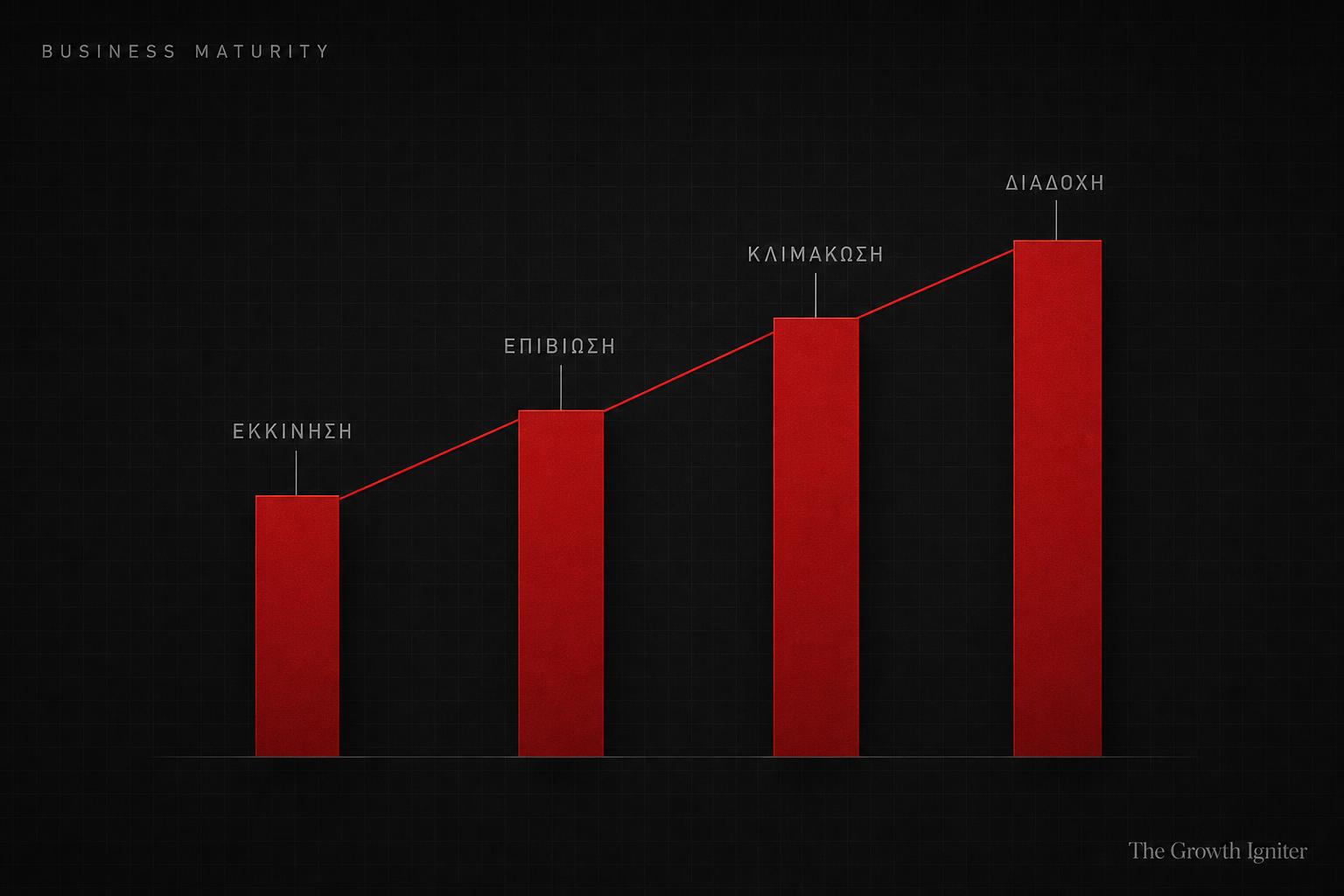
The four stages of business maturation
An entrepreneur's evolution is not linear. It is a series of internal transformations.
01 · 0–2 years
Startup
Initial market validation
02 · 2–5 years
Survival
Break-even (financial & psychological)
03 · 5–10 years
Scaling
Founder stepping back from day-to-day operations
04 · 10+ years
Succession / Exit
Value beyond the founder
1. Startup — “I am the business”
In the early years, entrepreneurs are everywhere. Selling. Producing. Fixing. Chasing payments. Talking to the accountant. Setting up marketing. Closing deals. Putting out fires.
Energy is high. Clarity, however, is not always there. At this stage, the business does not yet have a system. It has a founder.
Critical milestone: not the MVP, but the first real validation from the market — a customer who buys from you not because they know you, but because what you offer has value.
2. Survival — “Selling is not enough. I have to endure”
After the initial enthusiasm comes reality: cash flow, taxes, social insurance obligations, late payments, hires that do not work out, customers who demand more than they pay for.
“Profitability on paper does not save a company. Liquidity does.”
This is the period when the “I do everything myself” model begins to break down. And that is where the first major leadership lesson emerges:
If everything goes through you, you do not have a company. You have an exhausted self with a tax identification number.
The critical milestone here is break-even. But not just financially — psychologically, too. It is the moment the founder begins to trust that the business can stand a little more firmly on its own feet.
3. Scaling — “I have to fire myself from day-to-day operations”
Between years 5 and 10, the business faces a new question. Not “how will we survive?” but “how will we grow without falling apart?”
Scaling is not just about more sales. It is the system's ability to handle more energy without creating more friction.
This is Growth Igniter territory:
Momentum = (Useful Energy − Friction) × Alignment
- • If you increase energy without reducing friction, you do not create growth. You create noise.
- • If you add people without clear roles, you do not create a team. You create confusion.
- • If you enter new markets without strategic alignment, you do not create an international outlook. You create fragmentation.
Critical milestone: the founder stepping back from day-to-day operations. Not their absence — their elevation.
- • From operator to architect.
- • From firefighter to systems designer.
- • From control center to source of direction.
4. Succession or Exit — “What is the company worth without me?”
The hardest question for an entrepreneur is not always financial. It is existential: “If I leave, what remains?”
In Northwestern Europe, in markets such as England or Germany, the build-to-sell mindset is more commonplace. The company is more often treated as an asset: something that is built, systematized, gains value, and at some point can be sold or move into a new cycle.
In Greece, the company is often treated like a child. And no one readily sells their child. This creates strength, dedication, resilience — but also traps.
When emotional attachment becomes managerial dependence, the company does not mature. It remains tied to the founder's nervous system.
“The question is not just whether you will sell the company. The question is: have you built a company that could be bought? — even if you never sell it.”
Build-to-sell does not mean sell
For a Greek entrepreneur, build-to-sell should not be viewed narrowly as a sale strategy. It should be viewed as a maturation strategy.
It means building a company with value beyond your personal presence. A company with:
- • clean financial figures,
- • standardized processes,
- • recurring revenue,
- • strong middle management,
- • protected intellectual property,
- • a distinctive market position,
- • customer relationships that do not depend exclusively on the founder,
- • and a model that can scale.
The three-question test
If you are a founder, entrepreneur or CEO, ask yourself three questions:
01 · Test
Can I be away for a month without the company grinding to a halt?
If the answer is no, the company does not yet have a system. It has a dependency.
02 · Test
Where does the business's real value lie?
In your personal relationships and abilities? Or in contracts, processes, team, brand, IP and recurring revenue?
03 · Test
If a serious buyer conducted due diligence tomorrow, what would frighten them?
It is not just about the exit — it is about your business maturity. A company that cannot withstand scrutiny is not ready for the next level.
A company that cannot withstand scrutiny is not yet ready for the next level.
The 4 criteria that make a company Ready-to-Sell
The entrepreneur's true coming of age
Business maturation is not the company's age. There are 20-year-old businesses that still operate as though they were in their second year. And there are 5-year-old businesses that have already built structures, rhythm, management and commercial autonomy.
The difference is not time. It is the founder's transformation.
That is where real growth begins. Not when the company simply grows in revenue — but when it grows in autonomy.
“Growth is not about running harder. Growth is about building a system that can move with less friction, more alignment and greater useful energy. That is momentum.”
Frequently asked questions
What is business maturity?
It is the founder's transition from the center of the business to its architecture. It is measured not in years or revenue, but in the company's ability to operate without everything going through the founder.
What are the 4 stages of business maturation?
1) Startup (“I am the business”), 2) Survival (“selling is not enough; I have to endure”), 3) Scaling (“I have to fire myself from day-to-day operations”), 4) Succession or exit (“what is the company worth without me?”).
What does build-to-sell mean for a Greek entrepreneur?
It does not necessarily mean you will sell the company. It means building a company with value beyond your personal presence — with clean financials, processes, recurring revenue, strong middle management, IP and a brand that can stand up to due diligence.
What are the 4 criteria that make a company Ready-to-Sell?
Founder Decoupling (independence from the founder), Financial & Legal “Health,” Recurring Revenue (Recurring Revenue / ARR) and Scalability with an International Outlook.
What is the three-question test?
1) Can I be away for a month without the company grinding to a halt? 2) Where does the business's real value lie — in me or in systems, team, brand, IP, recurring revenue? 3) If due diligence took place tomorrow, what would frighten the buyer?
Why is business maturation more difficult in Greece?
Because entrepreneurship here is personal risk, a family burden and social validation — not simply economic activity. The founder becomes the most critical asset and, at the same time, the biggest bottleneck.
Growth Strategy Session
Ready to see your company without you at the center?
In a Growth Strategy Meeting, we can map out your business's stage of maturation, identify the next milestone, and design the moves that shift the founder from the center to the architecture. Decisions you can execute on Monday.
Related Insights
More from the field.
Insight
The truth about succession in family businesses
Family council and succession architecture.
Insight
Hero Trap & Bus Factor
When dependence on 2 people is labeled “culture.”
Insight
Causal Reductionism: The Single-Cause Trap
Why a single explanation hides the real system.
Insight
Return on Energy is the new ROI
We measure output. But first, the organization must be able to move.