
AI Strategy · Operations
AI speeds up work. Who will eliminate the waiting?
A story involving 58 containers highlights a mistake we risk making with artificial intelligence: speeding up every task while leaving the system that connects them untouched.
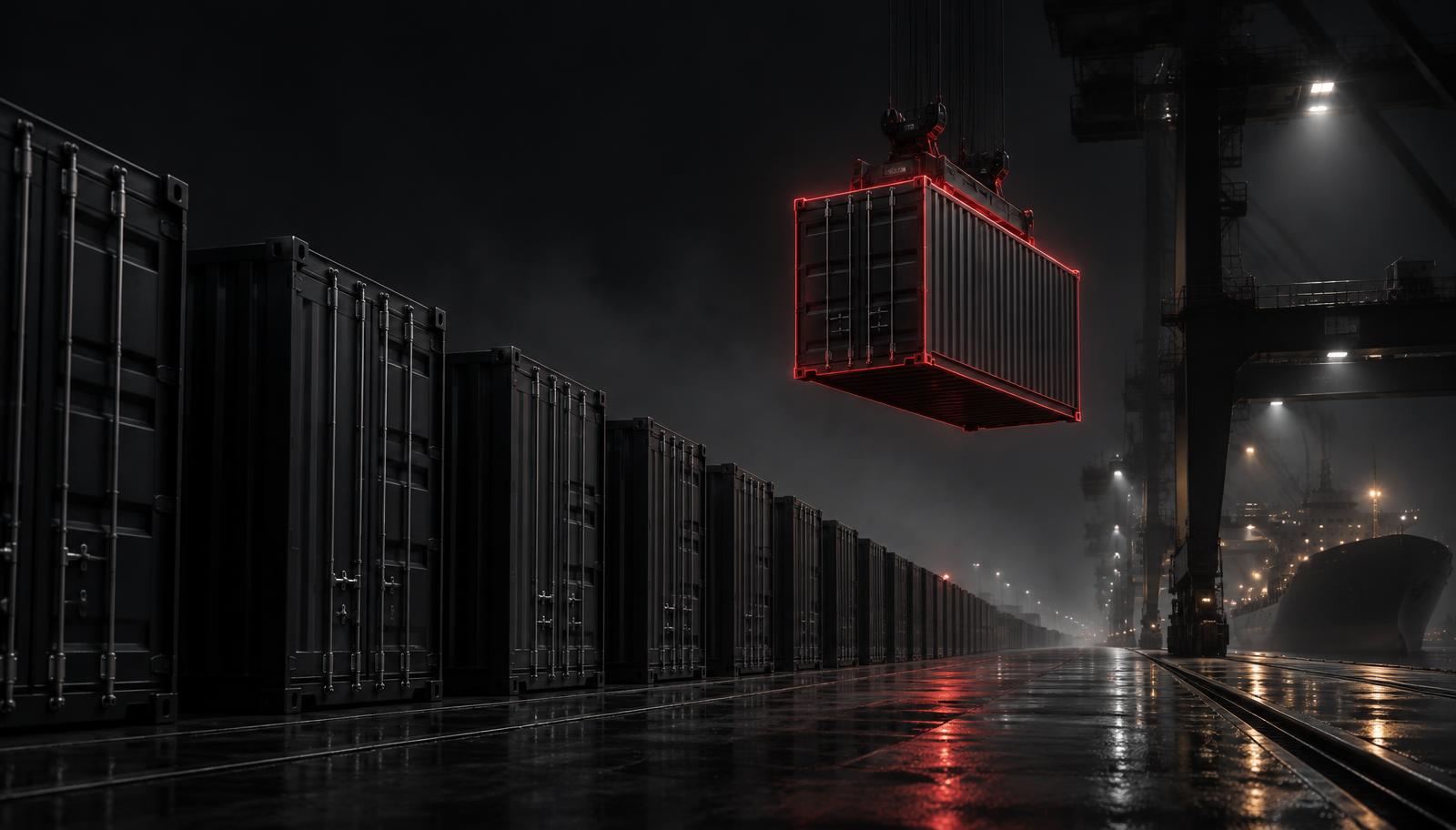
On 26 April 1956, the Ideal-X departed from New Jersey for Houston, carrying 58 metal containers. As Christos Kotsakas recounts in his article on BizNow.gr, “The Revolution That Began with 58 Boxes”, the transport entrepreneur Malcom McLean was behind the venture.
His contribution was not that he invented the metal box. It was that he integrated it into a different way of organizing transport.
To understand the difference, we need to look at where time was being lost.
Goods arrived at the port, were unloaded, recorded, stored and loaded again, one by one, onto the ship. At the destination, the process was repeated. A ship could remain docked for days or weeks, waiting for its cargo to be handled.
Here lies the distinction that makes this story so useful to the discussion about AI:
The speed at which something moves is one thing; the time it takes to reach its destination is another.
The latter also includes all the hours when it stands still.
A company has its own ports too
Let us take this image into a hypothetical business.
A team prepares a recommendation. With AI's help, the first version is completed in twenty minutes instead of three hours. An excellent result.
Then, however, the recommendation waits two days for review. It comes back because someone used different data. It is rewritten to fit the format preferred by the next department. It is forwarded to a director who is unsure whether they have the authority to decide. It ends up with the CEO.
By the time the decision is finally made, a week has passed.
| Stage | Time | What it means |
|---|---|---|
| Preparing a recommendation | 3 hours → 20 minutes | A dramatic acceleration of the individual task. |
| Waiting for review | 2 days | The time when work stands still, outside the measurement. |
| Repetition and formatting | Rewriting, new data | Context is lost and rebuilt from scratch. |
| Path to the decision | 1 week | The only metric the customer and the market see. |
Producing the document became dramatically faster. The path to the decision barely did. This is the corporate equivalent of a faster ship still waiting at the same port.
And there is an even more unpleasant possibility: if AI increases the number of recommendations reaching an already overloaded person without changing how they are assessed and decisions are made, the queue may grow.
More output. More to approve. Longer waits. Individual productivity may increase while the overall operation becomes slower.
Not because the tool failed. Because we improved production before examining the organization's capacity to make use of what is produced.
The major gains lie in the handoffs
In the history of containers, the crucial step was that cargo could move from truck to ship and from there to train without having to be broken down into hundreds of different items each time. Connection mechanisms and the establishment of common specifications allowed different modes of transport and businesses to operate as parts of the same journey.
Now let us look at how work travels through a company.
- • How many times does it need to be explained from scratch?
- • How many times is the same information copied into different files?
- • How many times does a team receive a result, but not the assumptions behind its creation?
These are knowledge transfers.
The next person receives the document but needs to rebuild the context. To learn what was requested, what has already been decided, which data is considered valid and which point remains open.
If every department acquires its own AI, it can perform this reconstruction faster. But it remains reconstruction. The same organizational cost recurs, simply with better tools.
This is where management's question is worth shifting. From “how can each team produce faster?” to:
“What must each team deliver so that the next one can actually carry on?”
AI can support this path. But it cannot replace the management decision that this will be the path.
The analogy has an important limit
In transport, the goal was for the contents to remain inside the box, without unnecessary handling along the way. In work with AI, we must not turn this idea into a requirement for results to pass unchecked from stage to stage.
An answer's correct format does not prove its accuracy. And the smooth circulation of a recommendation does not mean that the recommendation deserves approval.
So the goal is not to eliminate judgment. It is to separate judgment from repetitive processing. To retain the checks that identify substantive errors without retaining every file conversion, every repeated explanation and every approval that exists simply because “that is how it is done”.
The ability to check the result must travel with it: sources, assumptions, outstanding issues, responsibility.
Otherwise, rather than reducing friction, we may simply make an error travel faster.
When the path changes, the company changes too
The article also describes a second consequence of the spread of containers: businesses were able to organize their production differently, connecting facilities and markets over long distances. The container did not create globalization on its own, but it was an important part of its physical infrastructure.
Here lies the deeper parallel I propose with AI.
A technology acquires strategic significance when it allows us to question the organization we considered essential until yesterday.
In our hypothetical company, for example, does the recommendation need to keep passing through so many successive hands? Or could a team with shared information, different specialties and clear authority complete a larger part of the decision?
- • Which departments add specialized judgment?
- • Which stages exist mainly to transfer information?
- • Which approvals protect the business, and which simply preserve an old distribution of power?
The issue, therefore, is not limited to where we will place AI within the existing organizational chart. It is also about which elements of that chart we need to reconsider.
This is harder than buying software. Because it touches responsibilities, identities and decision rights.
The history of containers also includes the cost of the transition for dockworkers: less need for certain tasks, different requirements, negotiations and conflicts. It was not a change from which everyone benefited in the same way.
We do not need to assume that AI will follow the same trajectory to take this warning seriously.
If you ask an employee to share their knowledge while they believe that doing so undermines their position, their reluctance cannot be resolved with a tools seminar.
There needs to be an honest discussion about changing roles, training, new responsibility and the terms of the transition. Organizational change has a human cost, not just technical specifications.
Before you buy more speed
The practical starting point can be very specific. Choose one recurring workflow: from a customer request to its resolution, from a sales opportunity to a proposal, from a problem to a decision.
Follow it from end to end.
Record how much time substantive work takes, how much time is spent waiting and how much is spent repeating work already done. Identify where context is lost, where responsibility is unclear and where a necessary check has become entangled with unnecessary processing.
Then decide what AI will support, what must be eliminated and what needs to remain a human decision.
And measure the result all the way to the final destination. Not just how quickly the first draft was created, but how quickly the work was completed correctly, with how many corrections and at what level of quality.
This, to me, is the substantive connection between the 58 boxes and AI. We can fill the business with tools that speed up every individual task. But if we leave waiting, repeated explanations and unclear responsibilities untouched, we will have modernized the means without changing the path.
Before you buy more speed, look at where you have organized waiting.
Starting point and source for the historical section: Christos Kotsakas, “The Revolution That Began with 58 Boxes”, BizNow.gr, 19 July 2026. The parallel with AI and the management implications are analysis presented in this article.
FAQ
What is the difference between speed and lead time?
The speed at which something moves is one thing; the time it takes to reach its destination is another. The latter also includes all the hours when work stands still: waiting for review, approvals, repeated explanations and file conversions.
Why can AI increase waiting time?
Because it increases the number of deliverables reaching an already overloaded decision point. If the way they are assessed and approved does not change, the queue grows: more output, more to approve, longer waits.
What are knowledge transfers?
They are the points where work changes hands and context is lost: something is explained from scratch, the same information is copied into new files, the next team receives the result but not the assumptions behind its creation.
What question should management ask?
Instead of “how can each team produce faster?”, the question becomes “what must each team deliver so that the next one can actually carry on?”. This requires a shared framework: what decision we are asking for, which sources, what is established fact and what is an assumption, what checks have been carried out, who is responsible.
How do I get started in practice?
Choose one recurring workflow and follow it from end to end. Record how much time is substantive work, how much is waiting and how much is repetition. Then decide what AI will support, what will be eliminated and what remains a human decision — and measure all the way to the final destination.
Growth Strategy Session
How much of your time is waiting rather than work?
In a Growth Strategy Meeting, we map one critical workflow: where context is lost, which approvals protect and which simply delay.
Related Insights
More from the field.
Insight
Every employee has their own AI.
Who is building collective intelligence?
Insight
AI brings speed. And that is the problem.
Clarity or automated chaos.
Insight
Your company has two organizational charts.
How power really moves.
Insight
Why is braking measured in meters?
Reflexes and correction distance.