
Strategy · Decision Making · Momentum
Do not decide on the details before deciding on the direction.
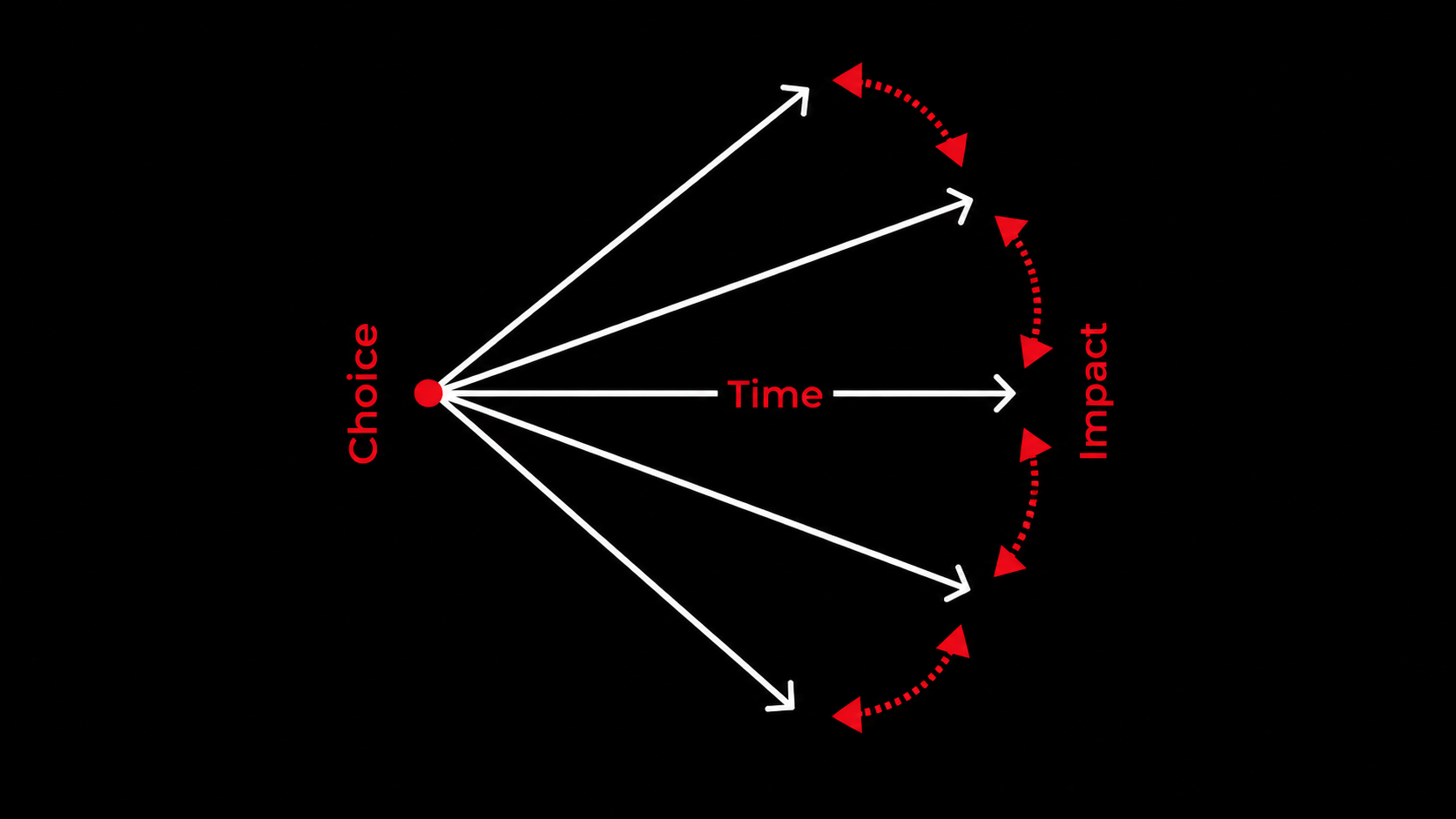
Decisions with multiplicative impact are made early — and shape dozens of decisions that follow.
I have seen leadership teams spend two hours discussing the price of a package. Spend weeks analyzing which CRM to choose. Disagree over whether a campaign should run on LinkedIn or Meta.
And at the same time, fail to clearly answer much bigger questions:
- • Who exactly do we want to sell to?
- • Which category do we want to play in?
- • How do we want to position ourselves in the market?
- • What business model do we really want to build?
The problem is not that they are focusing on the wrong decisions. The problem is that they treat all decisions as if they carry the same weight.
They do not.
Decisions with Multiplicative Impact
Some decisions affect a single move. Others affect the entire system. These are Decisions with Multiplicative Impact.
A decision has high multiplicative impact when its influence does not stop at the immediate outcome, but extends over time and shapes many of the decisions that follow.
Consider, for example, a company launching a new business unit.
| Decision | Multiplicative impact |
|---|---|
| The website color | Little influence on the system |
| The price | Greater |
| The target audience | Even greater |
| The business model | Affects everything, for years |
The decision about which business model the company will follow can affect the product, pricing, hiring, marketing, sales model, technology, margins, customer experience — even the company's culture — for years.
One decision.
Dozens of consequences that follow.
That is multiplicative impact. Decisions that determine direction have greater leverage than those that determine details.
The comfortable decision trap
Decisions with high multiplicative impact are usually difficult. They involve uncertainty. They require trade-offs. They close doors. They force you to say:
“We will go in that direction. And not in every possible direction.”
By contrast, small decisions are much more comfortable. We can analyze them. Build spreadsheets. Compare vendors. Hold meetings. Discuss features, colors, deadlines, and formats. And feel exceptionally productive.
Without having decided anything truly important. This creates a very dangerous illusion: plenty of activity around decisions, but little strategic movement.
Timing changes the power of a decision
The same decision does not have the same value at every point in time. A good decision made early can prevent dozens of wrong decisions later.
The same decision, if delayed by six months, may require:
- • restructuring
- • new budgets
- • personnel changes
- • team retraining
- • technology transitions
- • rebranding
- • missed opportunities
- • and a much greater political cost within the company
That is why a decision's timing is part of its quality.
Early clarity costs less than late correction.
One right decision can eliminate ten subsequent ones
Think of it as a chain. If you correctly decide who your ideal customer is, many other decisions automatically become easier.
- — You know what product they need.
- — You know how to communicate.
- — You know which channels you will find them in.
- — You know which objections you need to address.
- — You know what sales process you need.
- — You even know what kind of people you need to hire.
One good decision at the start of the system simplifies the entire chain that follows. Conversely, one vague initial decision creates hundreds of subsequent discussions.
And this is where organizational friction begins: meetings, rework, changes in direction, approvals, conflicting priorities.
- “Let's revisit this.”
- “I'm not sure this is right.”
- “Who exactly are we trying to reach?”
The company does not necessarily lack people who make decisions. It lacks decisions that resolve other decisions.
And then the CEO's role changes too
The CEO should not be the person who makes the most decisions. That is often a sign of poor organizational design.
They should be the person who protects the quality of the few decisions with a disproportionately large impact.
The CEO Shortlist
The few decisions that define the boundaries
- — Where the company will play.
- — Where it will not play.
- — Who the customer is.
- — What the real competitive advantage is.
- — Where capital will be invested.
- — Which people will fill critical roles.
- — Which capabilities need to be built.
- — Which things need to stop.
These decisions create the boundaries within which hundreds of other decisions can be made without their involvement.
The CEO makes fewer decisions. But their decisions become more powerful. Because the right decision does not just create an outcome. It creates clarity. And clarity creates alignment.
When there is alignment, the need for approvals, corrections, endless meetings, and micromanagement decreases. Energy begins to move in the same direction.
In Growth Igniter terms
Momentum = (Useful Energy − Friction) × Alignment
Decisions with multiplicative impact affect all three variables. They direct energy. They reduce friction. They increase alignment. That is why they can change the speed of an entire organization.
The question worth your time
So the next time your calendar is full of decisions, do not just ask yourself: “What do I need to decide today?”
“Which decision, if I get it right today, will make ten other decisions tomorrow easier or unnecessary?”
That is where your time is worth investing.
Because leadership is not about deciding everything.
It is about recognizing which few decisions determine almost everything else.
FAQ
What is a decision with multiplicative impact?
It is a decision whose influence does not stop at the immediate outcome, but extends over time and shapes many of the decisions that follow — product, pricing, hiring, marketing, sales model, technology, margins, culture.
Why do teams focus on small decisions?
Because they are more comfortable. They can be analyzed, entered into spreadsheets, vendors can be compared, and meetings can be held. They create a sense of productivity without anything truly important having been decided.
Why does timing change the value of a decision?
A good decision made early prevents dozens of wrong decisions later. The same decision delayed by six months may require restructuring, new budgets, personnel changes, rebranding, and a much greater political cost.
How do I measure Decision Leverage?
Decision Leverage ≈ Scope of Influence × Duration × Number of Subsequent Decisions. You do not need to calculate it — simply view decisions through this lens.
What is the CEO's role in decisions?
The CEO should not make the most decisions. They should protect the quality of the few decisions with a disproportionately large impact, creating the boundaries within which hundreds of other decisions are made without their involvement.
Growth Strategy Session
Do you want to identify the few decisions that determine all the others?
In a Growth Strategy Meeting, we can map out which decisions truly have multiplicative impact, which are being delayed, and what that delay costs.
Related Insights
More from the field.
Insight
Your company has two organizational charts
How power really moves within the organization.
Insight
If you want decision-makers, accept decision mistakes
The cost of autonomy in decision-making.
Insight
Causal Reductionism
The single-cause trap in decision-making.
Insight
When ego is present, momentum is lost
How ego acts as friction in leadership.